
A course of action is recommended as a means to a goal the actor is already pursuing. The argument works because the goal is already wanted, so any action that serves it inherits that wanting: this is what the actor is trying to achieve, so this is what the actor should do. You can attack it by showing that the action is not a good route to the goal, or that a better route exists.
Example
The University of Amsterdam should invest in AI research because it should foster innovation
Standardized form
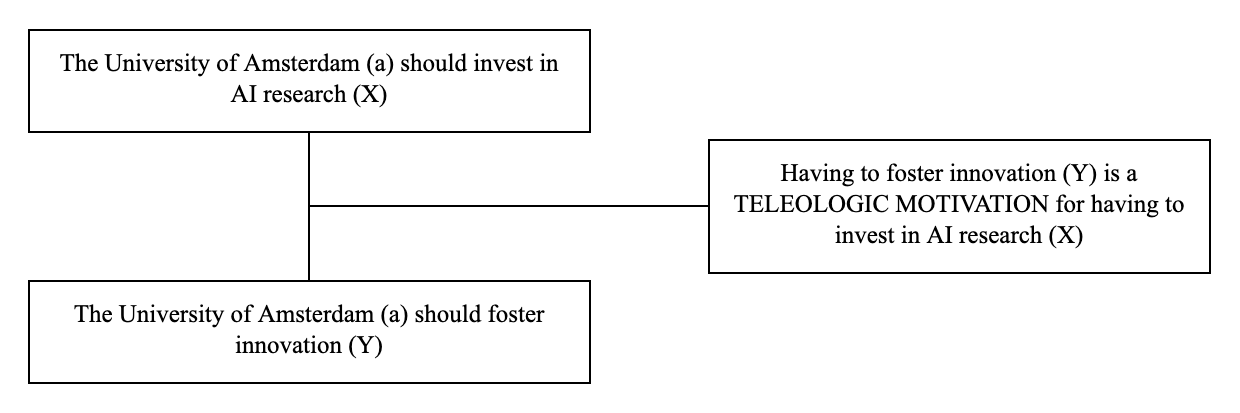
The University of Amsterdam (a) should invest in AI research (X) because the University of Amsterdam (a) should foster innovation (Y).
Transformations applied: anaphora resolved — “it” replaced by “the University of Amsterdam”.
Classification
The subject is the same in both statements and the predicates differ, so the argument form is alpha (a is X because a is Y).
The conclusion “should invest in AI research” is a statement of policy (P) and the premise “should foster innovation” is a statement of policy (P), so the argument substance is PP.
The keyword TELEOLOGIC MOTIVATION describes the relationship between predicates Y and X. The argument lever can thus be formulated as “Having to foster innovation (Y) is a TELEOLOGIC MOTIVATION for having to invest in AI research (X)”.
Assessment questions
- Is it acceptable that the University of Amsterdam should foster innovation?
- Is investing in AI research a means to the goal of fostering innovation — does the goal give a reason for this particular investment?
- Is that goal enough to conclude that the university should invest in AI research, or are there better routes to innovation, or other goals — teaching, other fields of research — competing for the same money?
Not to be confused with
- Deontic argument — The premise expresses an obligation owed rather than an end pursued.
DEONTIC MOTIVATION - Pragmatic argument — Substance: the premise forecasts what the action will bring about.
PF - Argument from principle — Substance: the premise passes a moral verdict on the action.
PV - Argument from evaluation — Substance: the premise rates the activity as worth doing.
PV
Other examples
- “Cities (a) should ban smoking in public spaces (X) because cities (a) should protect citizens’ health (Y).” — source not yet recorded.
Notes
This argument type is similar to the deontic argument, but here the premise expresses an end (telos) rather than an obligation (deon). On taking the actor rather than the activity as the subject, see the note on the deontic argument.
Source of the example
Source not yet recorded.

