
A judgment is supported by naming a more specific version of the very quality being claimed. The argument works because the supporting quality is one of the forms the general quality can take — being tragic is one way of being moving — so having the specific version means having the general one. You can attack it by denying that the two really stand as kind to sub-kind, treating them instead as different things altogether.

Example
The story of Oedipus is moving because it is tragic
Standardized form
The story of Oedipus (a) is moving (X) because the story of Oedipus (a) is tragic (Y).
Transformations applied: anaphora resolved — “it” replaced by “the story of Oedipus”.
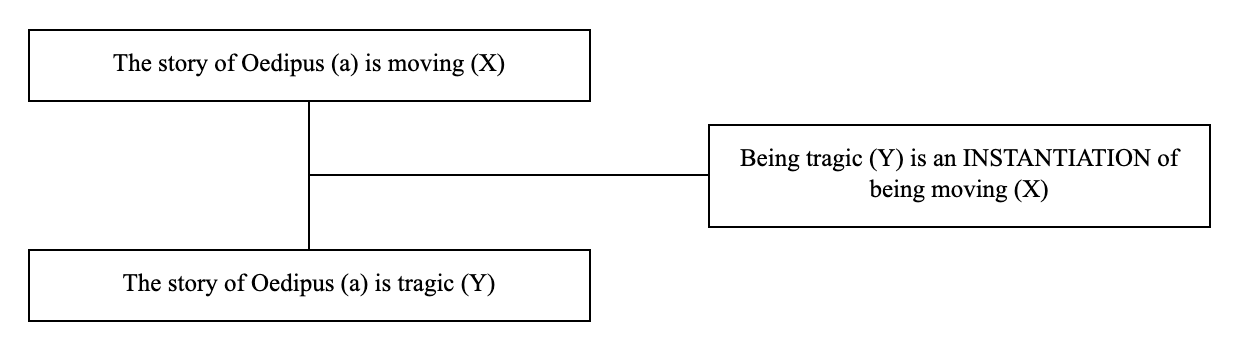
Classification
The subject is the same in both statements and the predicates differ, so the argument form is alpha (a is X because a is Y).
The conclusion “is moving” is a statement of value (V) and the premise “is tragic” is a statement of value (V), so the argument substance is VV.
The keyword INSTANTIATION describes the relationship between predicates Y and X. The argument lever can thus be formulated as “Being tragic (Y) is an INSTANTIATION of being moving (X)”.
Assessment questions
- Is the story of Oedipus indeed tragic?
- Is being tragic an instantiation of being moving — one of the forms that being moving can take?
- Is the story’s being tragic enough to conclude that it is moving, or can a tragedy leave a reader cold — because of its telling, its distance in time, the reader’s own response — so that more is needed than the genre alone?
Not to be confused with
- Argument from norm — The premise names a separate quality serving as a standard, not a kind of the quality claimed.
NORM - Argument from disqualifier — The premise qualifies a label the conclusion denies.
DISQUALIFIER - Argument from subsumption — Substance, not lever: there the premise is a description rather than a verdict.
VF - Argument from evaluation — Substance: the conclusion recommends doing something.
PV
Notes
One could argue that this argument type is a variant of the argument from norm. The difference is that here the premise-predicate is not just another value predicate but a specific case of the conclusion-predicate.
Source of the example
Source not yet recorded.

