
One obligation is derived from another. The argument rests on the rule that whoever is bound to an end is bound to the means: once someone must reach a certain goal, they are held to the step that gets them there. You can attack it by denying the larger obligation, or by showing it can be reached without taking this particular step.
Example
We should decarbonize the power sector because we should reach net-zero emissions by 2050
Standardized form
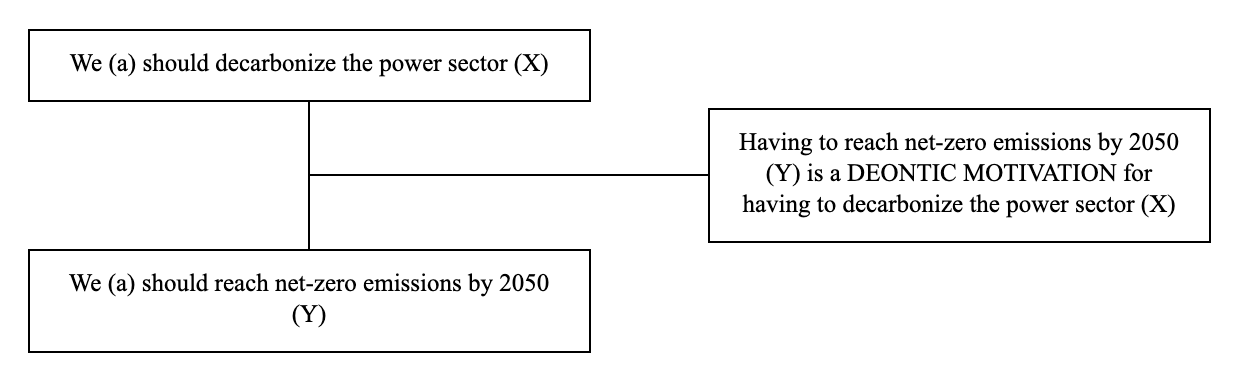
We (a) should decarbonize the power sector (X) because we (a) should reach net-zero emissions by 2050 (Y).
Transformations applied: none — the example is already in canonical form.
Classification
The subject is the same in both statements and the predicates differ, so the argument form is alpha (a is X because a is Y).
The conclusion “We should decarbonize the power sector” is a statement of policy (P) and the premise “We should reach net-zero emissions by 2050” is a statement of policy (P), so the argument substance is PP.
The keyword DEONTIC MOTIVATION describes the relationship between predicates Y and X. The argument lever can thus be formulated as “Having to reach net-zero emissions by 2050 (Y) is a DEONTIC MOTIVATION for having to decarbonize the power sector (X)”.
Assessment questions
- Is it acceptable that we should reach net-zero emissions by 2050?
- Does the obligation to reach net-zero emissions by 2050 give rise to an obligation to decarbonize the power sector — is the one duty relevant to the other?
- Is the 2050 obligation enough to conclude that we should decarbonize the power sector, or could the target be reached in other ways — through other sectors, through carbon removal — so that this particular step is not required?
Not to be confused with
- Teleologic argument — The premise names an end the actor pursues rather than an obligation owed.
TELEOLOGIC MOTIVATION - Pragmatic argument — Substance: the premise predicts a consequence.
PF - Argument from principle — Substance: the premise passes a moral verdict on the activity.
PV - Argument from evaluation — Substance: the premise rates the activity as worth doing.
PV
Notes
This argument type is similar to the teleologic argument, but here the premise expresses an obligation (deon) rather than an end (telos). Unlike the pragmatic argument and the argument from principle, it takes the actor as the subject rather than the action.
Source of the example
Source not yet recorded.

