
One fact about something is inferred from another fact that is usually found alongside it. The argument works on nothing more than the two things tending to go together: no claim is made that either one produces the other. You can attack it by showing the pairing is a coincidence, or that a third factor underlies both, so the presence of one says nothing reliable about the other.
Example
He must eat a lot of meat because he is always so agitated.
Standardized form
He (a) must eat a lot of meat (X) because he (a) is always so agitated (Y).
Transformations applied: none — the example is already in canonical form.
Classification
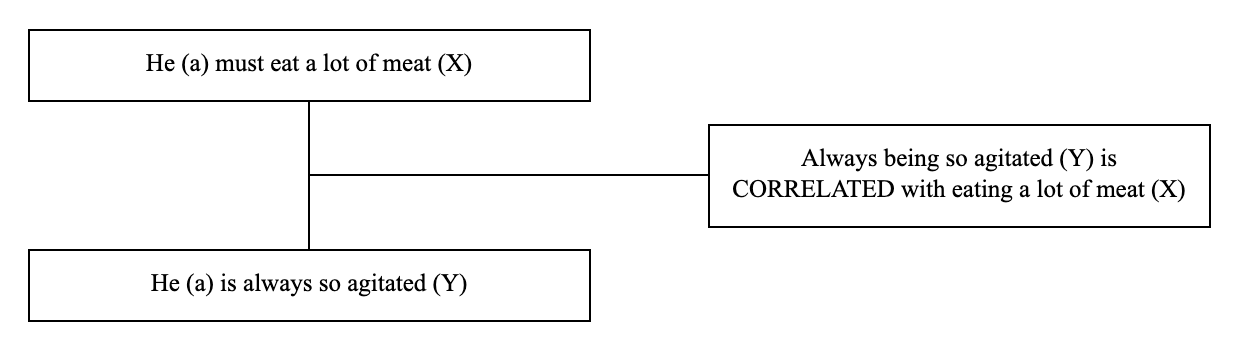
The subject is the same in both statements and the predicates differ, so the argument form is alpha (a is X because a is Y).
The conclusion “must eat a lot of meat” is a statement of fact (F) and the premise “is always so agitated” is a statement of fact (F), so the argument substance is FF.
The keyword CORRELATION describes the relationship between predicates Y and X. The argument lever can thus be formulated as “Always being so agitated (Y) is CORRELATED with eating a lot of meat (X)”.
Assessment questions
- Is he indeed always so agitated?
- Is being agitated correlated with eating a lot of meat — do the two in fact tend to be found together?
- Is his agitation enough to conclude that he eats a lot of meat, or could the pairing be a coincidence, or the work of a third factor — stress, caffeine, lack of sleep — that explains the agitation just as well?
Not to be confused with
- Argument from cause — The premise names what produced the state in the conclusion.
CAUSE - Argument from effect — The premise names what that state produced.
EFFECT - Argument from sign — The premise is offered as a reliable indicator, not merely as something that often coincides.
SIGN - Argument from motive — The premise names the reason a person has for acting.
MOTIVE
Source of the example
Source not yet recorded.

