
Judgment is passed on something by calling it something else entirely. The argument works because the approval or disapproval that attaches to the image is meant to settle on the thing described without ever being stated: nobody is asked to check whether the image is literally true, only to feel its force. You can attack it by questioning whether the image is apt — whether the thing really resembles what it is being called in the respect that carries the judgment.
Example
This leader is a captain who abandons ship
Standardized form
This leader (a) is bad (X) because a captain abandoning ship (b) is bad (X).
Transformations applied: ellipsis filled and “because” inserted — the example states only the metaphor, so the qualification it is meant to transfer, being bad, is supplied as the shared predicate of both halves.
Classification
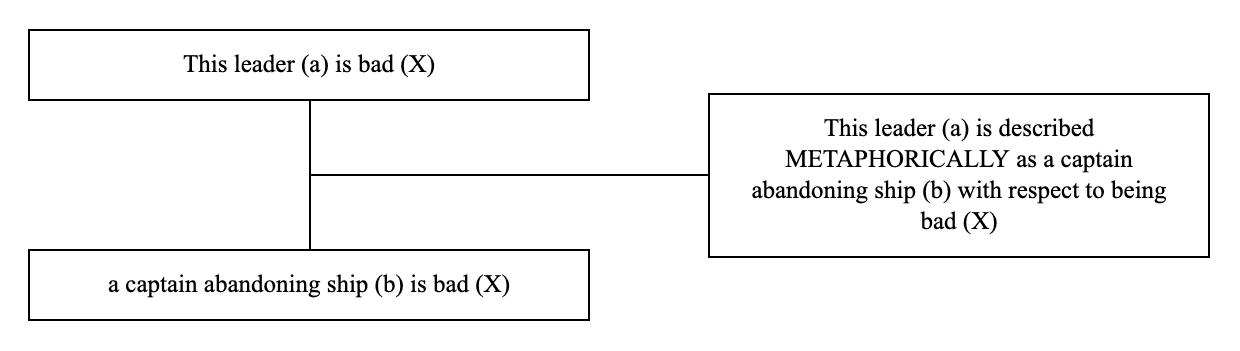
The subjects differ and the predicate is the same, so the argument form is beta (a is X because b is X).
The conclusion is about one specific leader (s) and the premise about one specific figure (s), so the argument substance is ss.
The keyword METAPHORICALLY describes the relationship between subjects a and b. The argument lever can thus be formulated as “This leader (a) is described METAPHORICALLY as a captain abandoning ship (b) with respect to being bad (X)”.
Assessment questions
- Is it acceptable that a captain who abandons ship is bad?
- Is this leader aptly described as a captain abandoning ship — does the image fit in the respect that carries the judgment, namely deserting those in one’s charge in a crisis?
- Is the image enough to conclude that the leader is bad, or does the metaphor leave out what would matter in the leader’s actual case — why they left, what alternatives they had, what they did before?
Not to be confused with
- Argument from comparison — The second case is a real comparable and the shared verdict is stated outright.
COMPARABLE - Argument from analogy — The likeness is asserted literally, in the respect that matters to the claim.
ANALOGOUS - Argument from similarity — The premise reports something that actually happened.
SIMILAR
Notes
Metaphors can be used in arguments in different ways (see Wagemans, 2016; van Poppel, 2021). In the metaphoric argument above, the metaphor is used as a lever, leaving implicit the qualification (being bad) that should be transferred from the source domain (captain abandoning ship) to the target domain (this leader).
van Poppel, L. (2021). The study of metaphor in argumentation theory. Argumentation, 35, 177–208. https://doi.org/10.1007/s10503-020-09523-1 Wagemans, J.H.M. (2016). Analyzing metaphor in argumentative discourse. Rivista Italiana di Filosofia del Linguaggio, 10(2), 79–94.
Source of the example
Source not yet recorded.

