
A claim is supported by saying it again in other words. The argument works because the support talks about something differently named and says something differently phrased about it, yet each is merely another way of putting what the claim already said, so accepting the one means accepting the other. You can attack it by pointing out that the support adds no independent reason to believe the claim, so the reasoning goes round in a circle.
Example
Freedom of speech is important because being able to say what you want is crucial
Standardized form
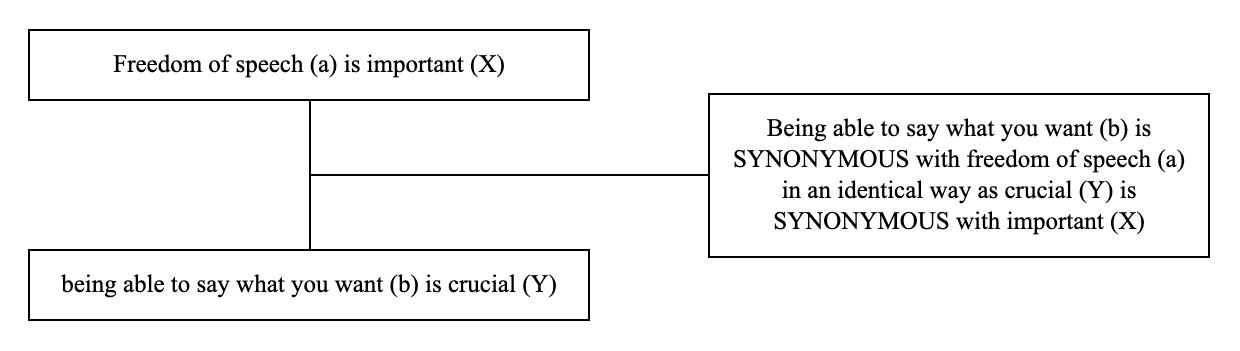
Freedom of speech (a) is important (X) because being able to say what you want (b) is crucial (Y).
Transformations applied: none — the example is already in canonical form.
Classification
Both the subjects and the predicates differ, so the argument form is gamma (a is X because b is Y).
The relation between the subjects “freedom of speech” and “being able to say what you want” is the same as the relation between the predicates “is important” and “is crucial”, so the argument substance is i.
The keyword SYNONYMOUS describes the relation that the subjects and the predicates both instantiate. The argument lever can thus be formulated as “Being able to say what you want (b) is SYNONYMOUS with freedom of speech (a) in an identical way as crucial (Y) is SYNONYMOUS with important (X)”.
Assessment questions
- Is being able to say what you want indeed crucial?
- Does being able to say what you want mean the same thing as freedom of speech, and does being crucial mean the same thing as being important?
- If the premise is merely a reformulation of the conclusion, does it add any support at all, or does the argument presuppose what it sets out to prove?
Not to be confused with
- Argument from opposites — The matching relation is opposition rather than sameness of meaning.
OPPOSITE - Argument from derivatives — One term is formed from the other.
DERIVATIVE - Argument from integratives — The relation is part to whole.
INTEGRATIVE - Non sequitur — Substance, not lever: the two relations do not match, so no lever can be formulated.
d
Notes
Many scholars consider this type of argument to be fallacious, because the premise does not introduce any genuinely new or independent support for the conclusion. Instead the premise merely restates the conclusion in a slightly different form, and so fails to increase the conclusion’s acceptability or persuasiveness. Since the reasoning simply goes in a circle, assuming what it sets out to prove, this fallacy is traditionally referred to as petitio principii, or, more commonly, as “circular reasoning”.
Source of the example
Source not yet recorded.

