
A reason is offered that has no bearing on the claim at all: it talks about something else and says something unrelated about it. There is no mechanism to make it work, because no connection can be found either between the two things talked about or between the two things said. It needs no attack, since there is nothing to attack; when it turns up in real discourse, the useful response is to ask what link the speaker had in mind and left unsaid.
Example
The moon is made of cheese because Máxima is queen of the Netherlands
Standardized form
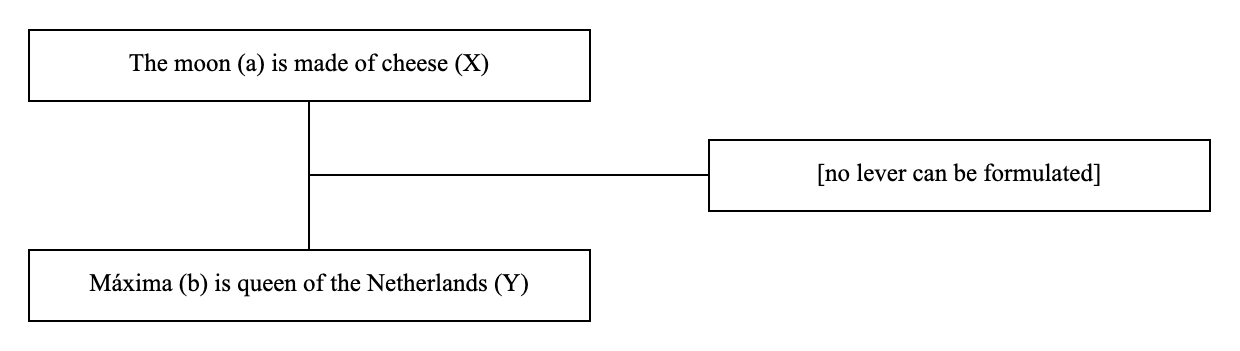
The moon (a) is made of cheese (X) because Máxima (b) is queen of the Netherlands (Y).
Transformations applied: none — the example is already in canonical form.
Classification
Both the subjects and the predicates differ, so the argument form is gamma (a is X because b is Y).
The relation between the subjects “the moon” and “Máxima” is different from the relation between the predicates “is made of cheese” and “is queen of the Netherlands”, so the argument substance is d.
No keyword can be found, because there is no meaningful semantic link between the subjects and none between the predicates. Since no lever can be formulated, the argument is identified as a non sequitur.
Assessment questions
- Is Máxima indeed queen of the Netherlands?
- Can any relation be formulated between the moon and Máxima that matches a relation between being made of cheese and being queen of the Netherlands — or, failing that, an intermediate statement the arguer left implicit that would connect the two?
- Given that none can, does Máxima’s being queen of the Netherlands provide any support at all for the moon being made of cheese?
Not to be confused with
- Argument from synonyms — The two relations match, and the relation is sameness of meaning.
i - Argument from opposites — The two relations match, and the relation is opposition.
i - Argument from derivatives — The two relations match, and one term is formed from the other.
i - Argument from integratives — The two relations match, and the relation is part to whole.
i
Other examples
- “Bananas (a) are square (X) because the internet (b) is fast (Y).” — invented example.
- “Mount Everest (a) is made of glass (X) because my neighbor (b) owns a cat (Y).” — invented example.
- “He (a) must have gone to the pub (X), because the interview (b) was canceled (Y).” — invented example; but see the Notes below.
Notes
In some cases the impossibility of formulating a lever is a sign that information has remained implicit. We are then dealing with a “condensed” gamma-form argument, and the analyst can use a step-by-step procedure to spell out the missing information (see Saadat-Yazdi & Wagemans, forthcoming).
Source of the example
Invented example.

