
A claim is said to deserve acceptance because nobody has shown it to be false. The argument works by shifting the burden of proof: in the absence of a refutation, the claim is treated as standing by default, so the silence of its opponents is offered in place of any evidence for it. You can attack it by pointing out that a claim can be unrefuted simply because nobody has looked, and that absence of evidence counts as evidence of absence only where the evidence would have turned up if it existed.
Example
Ghosts exist, because nobody has ever proved that they don’t.
Standardized form
“Ghosts exist” (q) is acceptable (A) because “ghosts exist” (q) has never been refuted by anyone (Z).
Transformations applied: the claim’s acceptability made explicit as the conclusion-predicate; “nobody has ever proved that they don’t” rendered as “has never been refuted by anyone”.
Classification
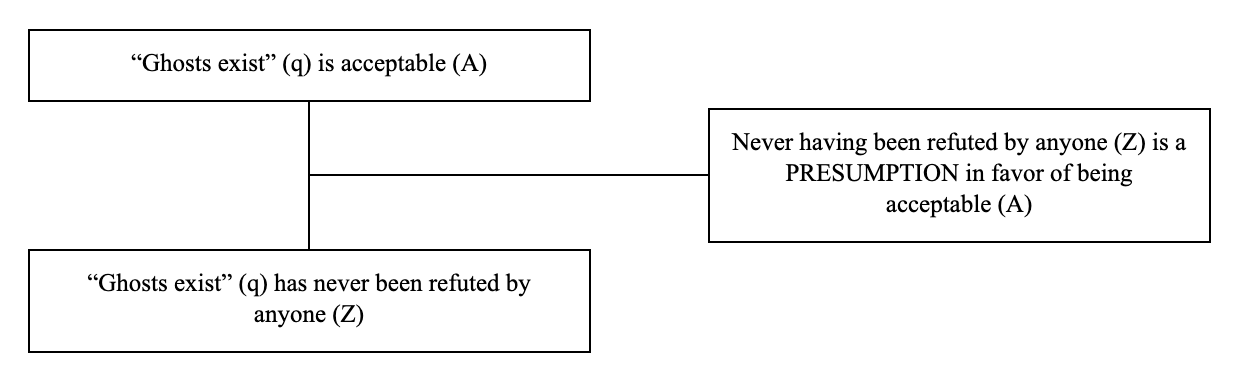
The conclusion is referred to as a whole in the premise, so the argument form is delta (q is A because q is Z).
The premise attributes the absence of refutation to third parties in general, so the argument substance is III.
The keyword PRESUMPTION describes the relationship between predicates Z and A. The argument lever can thus be formulated as “Never having been refuted by anyone (Z) is a PRESUMPTION in favor of being acceptable (A)”.
Assessment questions
- Is it true that nobody has ever proved that ghosts don’t exist?
- Is the absence of a refutation relevant to whether ghosts exist — has anyone actually looked, and would a refutation have been found if the claim were false?
- Is the absence of a refutation enough to accept that ghosts exist, or does the burden of proof lie with those who claim they do, so that positive evidence is required?
Not to be confused with
- Argumentum ad populum — Third parties are counted for what they assert, not for what they have failed to refute.
POPULARLY AUTHORITATIVE - Argument from expert opinion — A named third party is credited with knowledge; here nobody is credited with anything.
EPISTEMICALLY AUTHORITATIVE - Argumentum ad hominem — Substance and direction: the premise points at the addressee and attacks acceptability.
II,U
Notes
This is the traditional argumentum ad ignorantiam, first named by Locke. It is distinctive within the Delta quadrant in resting on a negative property of the statement — the absence of a refutation — where every other delta lever rests on a positive property of a source. Its mirror image, “the claim is unacceptable because nobody has ever proved it”, runs on the same lever with U in place of A.
Source of the example
Invented example.

