
A claim is supported by stating the same relation from the other end: if one party did the giving, the other party did the receiving. The argument works because the two subjects and the two predicates are converse pairs that describe a single relation, so asserting it from one side is the same as asserting it from the other. You can attack it by showing that the two predicates are not true converses because one side of the relation can hold without the other.

Example
The tenant must have received the notice, because the landlord sent it.
Standardized form
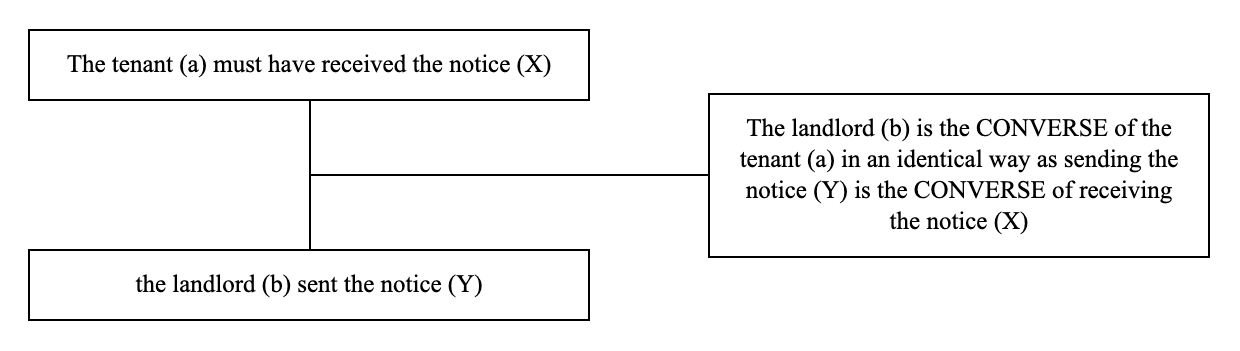
The tenant (a) must have received the notice (X) because the landlord (b) sent the notice (Y).
Transformations applied: anaphora resolved — “it” replaced by “the notice”.
Classification
Both the subjects and the predicates differ, so the argument form is gamma (a is X because b is Y).
The relation between the subjects “the tenant” and “the landlord” is the same as the relation between the predicates “received the notice” and “sent the notice”, so the argument substance is i.
The keyword CONVERSE describes the relation that the subjects and the predicates both instantiate. The argument lever can thus be formulated as “The landlord (b) is the CONVERSE of the tenant (a) in an identical way as sending the notice (Y) is the CONVERSE of receiving the notice (X)”.
Assessment questions
- Did the landlord indeed send the notice?
- Is the landlord the converse of the tenant in this relation, and is sending the notice the converse of receiving it — do the two predicates describe one and the same relation from its two ends?
- Is the landlord’s sending enough to conclude that the tenant received the notice, or can one side of the relation hold without the other — a notice sent but lost in the post, misaddressed or refused?
Not to be confused with
- Argument from opposites — The matching relation is opposition, not conversion: peace and war exclude each other, while sending and receiving complete each other.
OPPOSITE - Argument from derivatives — The two terms are grammatical forms of one word, not two ends of one relation.
DERIVATIVE - Argument from synonyms — The two statements mean the same thing said twice; here they describe one relation from two positions.
SYNONYMOUS - Argument from effect — Read as an alpha argument about the notice alone, the sending would be the cause of the receiving.
EFFECT
Notes
This type completes the family of topics that Aristotle treats as one group in the Topics and the Rhetoric: synonyms, opposites, inflections and correlatives (ta pros ti). The first three correspond to the arguments from synonyms, opposites and derivatives; the fourth is the argument from converses.
Source of the example
Invented example.

