
A claim is rejected because of what would follow if it were true. The argument works by treating the unwelcomeness of a state of affairs as evidence against it: the consequences of the claim’s being true are so undesirable that its being false is offered as the safer thing to believe. You can attack it by pointing out that the world is under no obligation to be agreeable, so how bad a truth would be has no bearing on whether it is one.
Example
Your theory cannot be right, because if it were, the last twenty years of your work would have been wasted.
Standardized form
“Your theory is right” (q) is unacceptable (U) because “your theory is right” (q) would, if true, mean that the last twenty years of your work were wasted (Z).
Transformations applied: “cannot be right” rendered as the claim’s unacceptability, made explicit as the conclusion-predicate; anaphora resolved — “it” replaced by “your theory is right”.
Classification
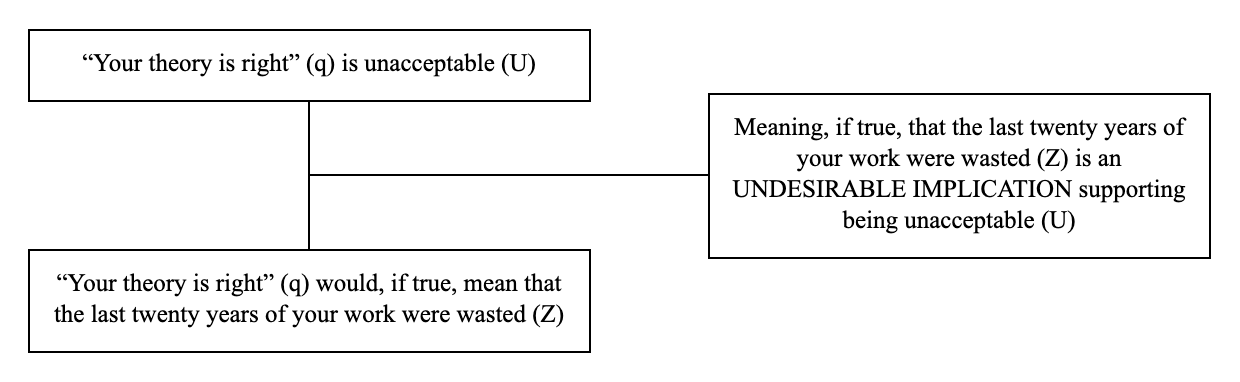
The conclusion is referred to as a whole in the premise, so the argument form is delta (q is U because q is Z).
The premise ties the consequence to the addressee, so the argument substance is II.
The keyword UNDESIRABLE IMPLICATION describes the relationship between predicates Z and U. The argument lever can thus be formulated as “Meaning, if true, that the last twenty years of your work were wasted (Z) is an UNDESIRABLE IMPLICATION supporting being unacceptable (U)”.
Assessment questions
- Is it true that, if the theory were right, the last twenty years of your work would have been wasted?
- Is the undesirability of that implication relevant to whether the theory is right — does how unwelcome a consequence is bear on whether the claim is true?
- Is the unwelcome implication enough to reject the theory, or must the theory be judged on the evidence for it, whatever it means for anyone’s past work?
Not to be confused with
- Argumentum ad baculum — The harm follows from accepting the claim, not from the claim’s being true.
NEGATIVE MOTIVATION - Argumentum ad hominem — The claim is attacked through the character of its source, not through what its truth would entail.
CHARACTERALLY AUTHORITATIVE - Pragmatic argument — Form: the consequences belong to an action, not to the truth of a statement.
alpha
Notes
This is the traditional argumentum ad consequentiam, or appeal to consequences. Its impersonal form — “free will must exist, because otherwise nobody could be held responsible” — ties the consequence to no particular person, which raises the question whether the Delta substance parameter (I, II, III) can capture every case; the second-person example is shown here because it settles that parameter cleanly.
Source of the example
Invented example.

