
The reasoning runs upward from the parts to the whole they make up: what is true of every part is claimed for the thing they compose. The argument works by treating the whole as nothing more than its parts put together, so that a quality shared by all the parts must belong to the whole as well. You can attack it by showing that a whole can have qualities that arise only when the parts work together, and lack qualities that each part has on its own.
Example
Who is so blind as not to see that the parts of the element earth and of the element water, being heavy bodies, move naturally downwards, namely toward the center of the universe, assigned by nature herself as the goal and end of straight downward motion… Since this can be seen clearly, and since we are sure that the same holds for the whole as for the parts, must we not conclude that the natural motion of the [whole globe] earth is straight toward the center…?
Standardized form
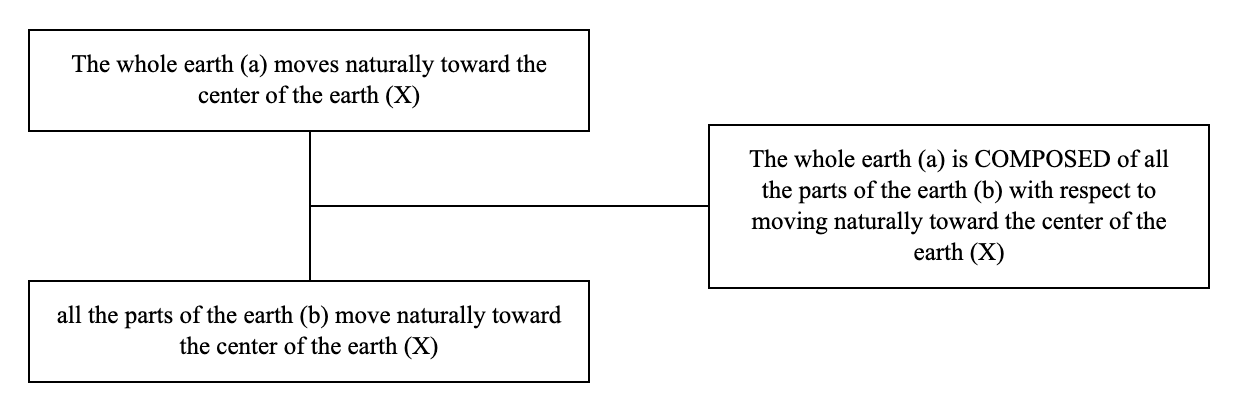
The whole earth (a) moves naturally toward the center of the earth (X) because all the parts of the earth (b) move naturally toward the center of the earth (X).
Transformations applied: rhetorical question converted into an assertion; “because” inserted; “downwards” disambiguated as “toward the center of the earth” (see Notes); the two predicates made verbally parallel.
Classification
The subjects differ, and the predicate is the same, so the argument form is beta (a is X because b is X).
The conclusion is about the earth taken as all of its parts together (u) and the premise about all the parts of the earth (u), so the argument substance is uu.
The keyword COMPOSED OF describes the relationship between subjects a and b. The argument lever can thus be formulated as “The whole earth (a) is COMPOSED of all the parts of the earth (b) with respect to moving naturally toward the center of the earth (X)”.
Assessment questions
- Do all the parts of the earth indeed move naturally toward the center of the earth?
- Is the whole earth composed of its parts in such a way that what holds of every part holds of the whole — is motion toward the center a property that transfers from the parts to the whole?
- Is the behavior of the parts enough to conclude that the whole earth moves toward its own center, or is motion toward the center a property that can hold only of the parts and not of the whole?
Not to be confused with
- Argument from division — The same relationship run the other way, from the whole down to its parts.
A PART OF - Argument from example — The premise offers one member as a specimen, not the complete set of parts.
us - Argument from species — The premise is a kind within a wider kind, not the components of a thing.
A SPECIES OF
Other examples
- “The whole machine has weight because all the parts of the machine have weight.” The whole machine (a) has weight (X) because all the parts of the machine (b) have weight (X). Offered by Finocchiaro (2015, p. 27) as his favorite example of a correct argument from parts to whole: deductively valid, though not formally so.
- “The Toronto Leaf Hockey team is good because all the hockey players in the team are good.” The Toronto Leaf Hockey team (a) is good (X) because all the hockey players in the team (b) are good (X). Invented example.
- “The universe as a whole is like a machine because its parts are like machines.” The step in the theological argument from design that Hume attacks through the character Philo in Dialogues Concerning Natural Religion (1779). Hume’s target speaks of many parts, which on a strict reading gives the substance up rather than uu. See Finocchiaro (2015, pp. 32–34).
Notes
One could argue that “the whole earth” is a singular statement (s). In the context of the argument, however, it is a cognitive shorthand for “all the parts of the earth”. For this reason, the subject type is universal (u) rather than singular (s). See also the argument from division, where the same choice is made. One could imagine a similar argument type with a particular statement (p) as a premise: “The whole earth moves naturally toward the center of the earth (u) because most of the parts of the earth move naturally toward the center of the earth (p)”. Since the substance is up, that argument type belongs to a different group of the Beta Quadrant.
The example is instructive because the premise is uncontroversially true while the conclusion is not merely false but incoherent: nothing can move toward its own center. Finocchiaro (2015, p. 32) calls this “an elegant, devastating, and memorable counterexample: a situation in which the key premise is clearly and uncontroversially true, and the conclusion is clearly and uncontroversially false”. Set beside the machine-weight example above, which runs the same beta / uu / COMPOSED OF pattern to a deductively valid conclusion, it shows that the transfer of a predicate from the parts to the whole is neither guaranteed nor barred by the shape of the argument, but is precisely what has to be evaluated in each case.
Much turns on how “downwards” is read. If it means toward the center of the universe, the argument begs the question against Copernicus, since it then presupposes that the center of the earth is the center of the universe. Only if it means toward the center of the earth is the premise a plain observational report, and it is on that reading that the conclusion becomes impossible. Which sense a term carries can thus decide whether the lever is available at all, which is why the choice belongs to the standardization step rather than the evaluation that follows.
Finocchiaro’s wider point is that textbook illustrations of compositional reasoning are “contrived or trivial”, and that real, historically consequential instances are worth hunting down. Besides the case above, he documents two others: Hume’s criticism of the design argument (see Other examples), and Robert Dahl’s and Seymour Martin Lipset’s criticisms of Michels’s “iron law of oligarchy”, which says that because political parties and unions are oligarchic, a society composed of them must be oligarchic too (2015, pp. 34–36).
Source of the example
Aristotle, On the Heavens 296b7–297a1, as reconstructed and criticized by Galileo Galilei, Galileo on the World Systems: A New Abridged Translation and Guide, translated and edited by Maurice A. Finocchiaro (Berkeley: University of California Press, 1997), pp. 83–84. Discussed in Maurice A. Finocchiaro, “The fallacy of composition: Guiding concepts, historical cases, and research problems”, Journal of Applied Logic 13 (2015), 24–43, at pp. 31–32.

