
A course of action is opposed by naming the wrong it would do, or supported by naming the right it would honor. The argument works because a rule or a right is taken to settle the matter on its own, so that the objection would hold even if the consequences turned out well. You can attack it by denying that the rule applies, that the right exists, or that the action really breaches it.
Example
New-born children should not be circumcised because that violates their right to self-determination
Standardized form
Circumcising new-born children (a) should not be done (X) because circumcising new-born children (a) violates their right to self-determination (Y).
Transformations applied: subject changed to the activity — “new-born children” replaced by “circumcising new-born children”; anaphora resolved — “that” replaced by the same phrase.
Classification
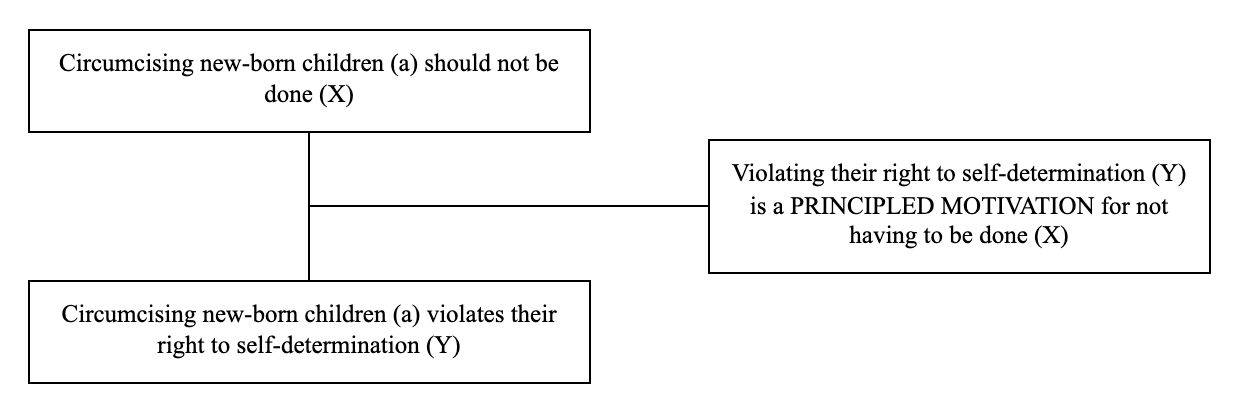
The subject is the same in both statements and the predicates differ, so the argument form is alpha (a is X because a is Y).
The conclusion “should not be done” is a statement of policy (P) and the premise “violates their right to self-determination” is a statement of value (V), so the argument substance is PV.
The keyword PRINCIPLED MOTIVATION describes the relationship between predicates Y and X. The argument lever can thus be formulated as “Violating their right to self-determination (Y) is a PRINCIPLED MOTIVATION for not having to be done (X)”.
Assessment questions
- Does circumcising new-born children indeed violate their right to self-determination?
- Is the violation of a right to self-determination a principled reason for not performing the practice — does this right settle the matter regardless of consequences?
- Is this principle enough to conclude that new-born children should not be circumcised, or are there competing principles and interests — religious freedom, parental authority, health benefits — that outweigh it?
Not to be confused with
- Argument from evaluation — The premise rates how good the activity is rather than naming a rule or right it breaches.
EVALUATIVE MOTIVATION - Pragmatic argument — Substance: the premise predicts a consequence rather than passing a verdict.
PF - Deontic argument — Substance: the premise is itself an obligation.
PP - Argument from norm — Substance: the conclusion is a verdict rather than a recommendation.
VV
Source of the example
Source not yet recorded.

