
What someone will do is predicted by naming the reason they have for doing it — a wish, an interest, an attachment. The argument works on the assumption that people act on their reasons, so a strong enough reason makes the action likely. You can attack it by showing that the person has a stronger reason to do something else, or that they do not in fact hold the reason ascribed to them.
Example
Bill will pay the ransom because he loves his wife and children
Standardized form
Bill (a) will pay the ransom (X) because Bill (a) loves his wife and children (Y).
Transformations applied: anaphora resolved — “he” replaced by “Bill”.
Classification
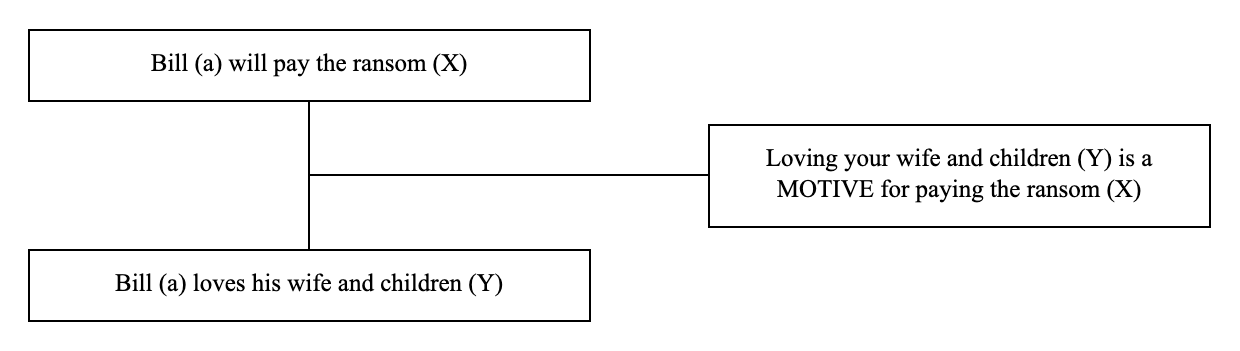
The subject is the same in both statements and the predicates differ, so the argument form is alpha (a is X because a is Y).
The conclusion “will pay the ransom” is a statement of fact (F) and the premise “loves his wife and children” is a statement of fact (F), so the argument substance is FF.
The keyword MOTIVE describes the relationship between predicates Y and X. The argument lever can thus be formulated as “Loving your wife and children (Y) is a MOTIVE for paying the ransom (X)”.
Assessment questions
- Does Bill indeed love his wife and children?
- Is love for one’s wife and children a motive for paying a ransom — a reason that moves a person to act in this way?
- Is this motive enough to predict that Bill will pay, or does he have stronger reasons not to — inability to raise the money, police advice, the fear that paying invites further demands?
Not to be confused with
- Argument from cause — What produces the action is a process rather than an agent’s reason.
CAUSE - Argument from sign — The premise names a mark of the conclusion rather than a ground for acting.
SIGN - Argument from correlation — The two facts merely go together; no reason for acting is named.
CORRELATION - Pragmatic argument — Substance, not lever: the conclusion tells someone what to do rather than predicting what they will do.
PF
Source of the example
Source not yet recorded.

