
The addressee is pressed to accept a claim because they have already granted it themselves. The argument works by holding people to their own record: having asserted something earlier, the addressee is taken to be committed to it, and that commitment, not any evidence, is what is offered for the claim. You can attack it by showing that the earlier statement was withdrawn, was made in a different sense, or was never made at all.

Example
You cannot deny that the deficit matters, because you said so yourself last week.
Standardized form
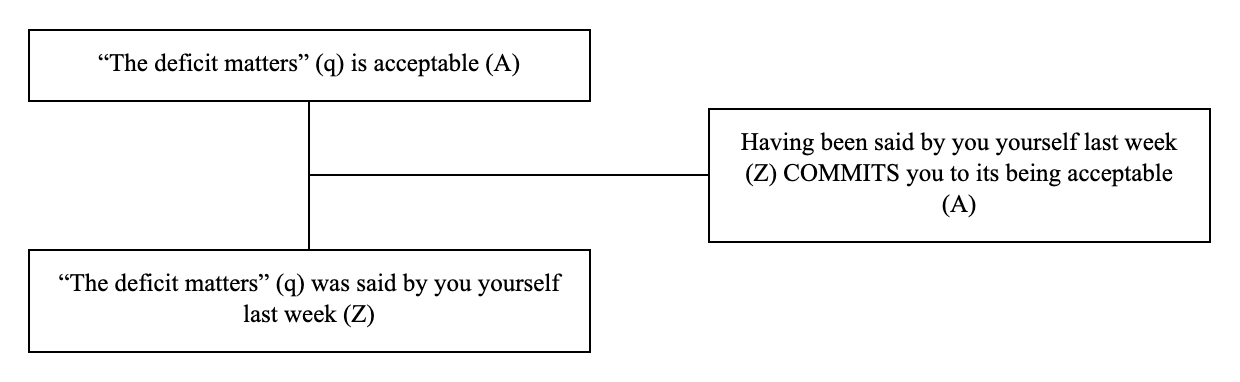
“The deficit matters” (q) is acceptable (A) because “the deficit matters” (q) was said by you yourself last week (Z).
Transformations applied: “you cannot deny that” rendered as the claim’s acceptability, made explicit as the conclusion-predicate; anaphora resolved — “so” replaced by “the deficit matters”.
Classification
The conclusion is referred to as a whole in the premise, so the argument form is delta (q is A because q is Z).
The premise attributes the conclusion to the addressee, so the argument substance is II.
The keyword COMMITS describes the relationship between predicates Z and A. The argument lever can thus be formulated as “Having been said by you yourself last week (Z) COMMITS you to its being acceptable (A)”.
Assessment questions
- Did you indeed say last week that the deficit matters?
- Does having said so commit you to accepting the claim now — was the earlier statement made in the same sense, and is it still in force?
- Is your earlier statement enough to accept that the deficit matters, or may you have changed your mind for good reasons since — new figures, a different context — so that the commitment can be withdrawn?
Not to be confused with
- Argumentum ad hominem — Also addressed to the second person, but it attacks a claim through the addressee’s character rather than defending one through their record.
CHARACTERALLY AUTHORITATIVE,U - Argumentum ad baculum — The addressee is given a motive to agree, not held to something they already agreed.
NEGATIVE MOTIVATION - Ethotic argument — The premise points at the arguer’s own standing, not the addressee’s prior statement.
I - Argument from expert opinion — The premise names a third party’s knowledge.
III
Notes
This is the argumentum ex concessis of the dialectical tradition and the basis of Locke’s argumentum ad hominem in its original, non-abusive sense: arguing from what the other party has granted. In the Delta quadrant it is the only type in which the addressee is invoked as a source of support rather than as a target.
Source of the example
Invented example.

