
A claim is supported by stating its mirror image. The argument works because the support talks about the opposite thing and says the opposite of it, and the two oppositions line up: if lies start wars, truth starts peace. You can attack it by showing that one of the pairs is not a true opposition, or that the two oppositions do not run parallel.
Example
Peace can be started by the truth because war can be started by lies
Standardized form
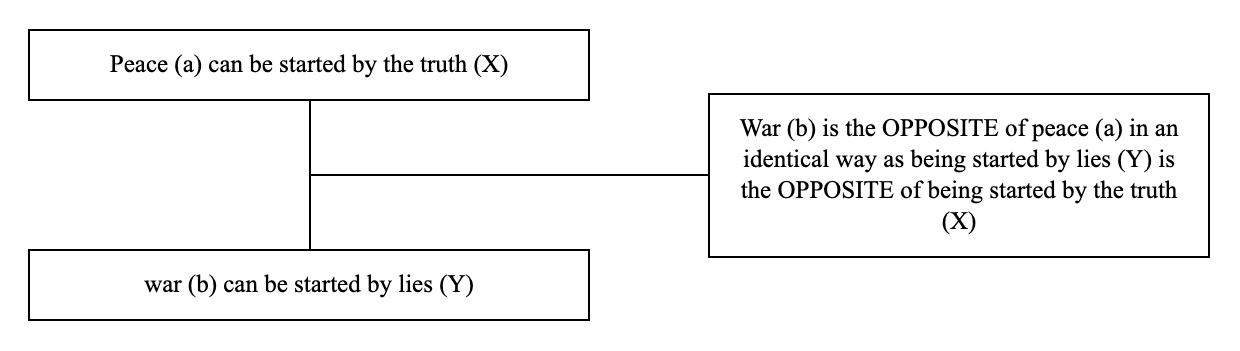
Peace (a) can be started by the truth (X) because war (b) can be started by lies (Y).
Transformations applied: none — the example is already in canonical form.
Classification
Both the subjects and the predicates differ, so the argument form is gamma (a is X because b is Y).
The relation between the subjects “peace” and “war” is the same as the relation between the predicates “can be started by the truth” and “can be started by lies”, so the argument substance is i.
The keyword OPPOSITE describes the relation that the subjects and the predicates both instantiate. The argument lever can thus be formulated as “War (b) is the OPPOSITE of peace (a) in an identical way as being started by lies (Y) is the OPPOSITE of being started by the truth (X)”.
Assessment questions
- Can war indeed be started by lies?
- Is war the opposite of peace, is being started by lies the opposite of being started by the truth, and are these two oppositions of the same kind?
- Is the fact that war can be started by lies enough to conclude that peace can be started by the truth, or does the parallel break down at some point — for instance, because starting a war requires far less than starting a peace?
Not to be confused with
- Argument from synonyms — The matching relation is sameness of meaning.
SYNONYMOUS - Argument from derivatives — One term is formed from the other.
DERIVATIVE - Argument from integratives — The relation is part to whole.
INTEGRATIVE - Non sequitur — Substance, not lever: the two relations do not match, so no lever can be formulated.
d
Other examples
- “False statements (b) are persuasive among mortals (Y), … many truths (a) turn out to be incredible to mortals (X).” — mentioned by Aristotle in his description of the topos “from opposites”, Rhetorica 1397a; taken from Euripides, Thyestes, fragment 396. Translation and information from G.A. Kennedy (1991), Aristotle, On Rhetoric: A Theory of Civic Discourse, p. 191. New York/Oxford: Oxford University Press.
- “Self-control (a) is good (X) because a bad temper (b) is bad (Y).” — source not yet recorded.
Source of the example
The example is based on a quotation by Julian Assange.


