
Something is said to deserve carrying on because so much has already been put into it. The argument works by treating the earlier investment as a reason in itself: to stop now would throw away what has been spent, so the spending is offered as a ground for continuing. You can attack it by pointing out that what has already been spent cannot be recovered whatever is decided, so it says nothing about whether continuing is worth it.
Example
We must finish the tunnel, because we have already spent two billion on it.
Standardized form
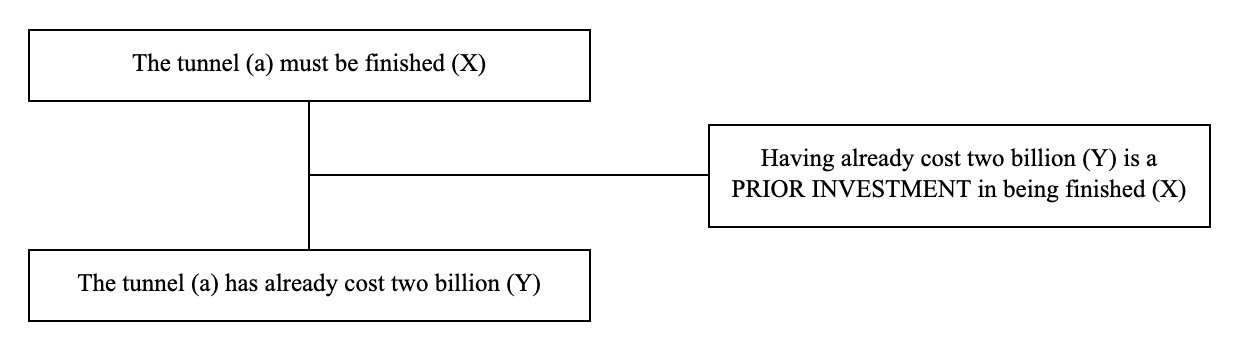
The tunnel (a) must be finished (X) because the tunnel (a) has already cost two billion (Y).
Transformations applied: the sentence recast so that the tunnel is the subject of both statements; anaphora resolved — “it” replaced by “the tunnel”.
Classification
The subject is the same in both statements and the predicates differ, so the argument form is alpha (a is X because a is Y).
The conclusion “must be finished” is a statement of policy (P) and the premise “has already cost two billion” is a statement of fact (F), so the argument substance is PF.
The keyword PRIOR INVESTMENT describes the relationship between predicates Y and X. The argument lever can thus be formulated as “Having already cost two billion (Y) is a PRIOR INVESTMENT in being finished (X)”.
Assessment questions
- Has the tunnel indeed already cost two billion?
- Is a prior investment of two billion a relevant reason for finishing the tunnel — does what has already been spent bear on what should be done now?
- Is the sum already spent enough to conclude that the tunnel must be finished, or does the decision rather depend on the remaining costs and the expected benefits, which the sunk cost does not change?
Not to be confused with
- Pragmatic argument — Looks forward to what the action will bring about; this argument looks back to what it has already cost.
PRAGMATIC MOTIVATION - Teleologic argument — The action is recommended as a means to a goal that is still wanted, not because of resources already spent.
TELEOLOGIC MOTIVATION - Deontic argument — Substance, not lever: the premise is itself an obligation, not a fact about expenditure.
PP
Notes
This type corresponds to what Perelman and Olbrechts-Tyteca call the argument of waste (argument du gaspillage) and to what economists describe as the sunk-cost fallacy. It is not a pragmatic argument: the pragmatic argument turns on a forecast, whereas this one turns on a fact about the past.
Source of the example
Invented example.

