
A general label is applied to a case by pointing out that the case already has a more specific name of its own. The argument works because the specific thing is one of the things the general label covers, so membership alone carries the label across, without the general term having to be spelled out in full. You can attack it by accepting the specific description and denying that it belongs under the general term.
Example
These prisoners have been subjected to torture because they have been subjected to waterboarding
Standardized form
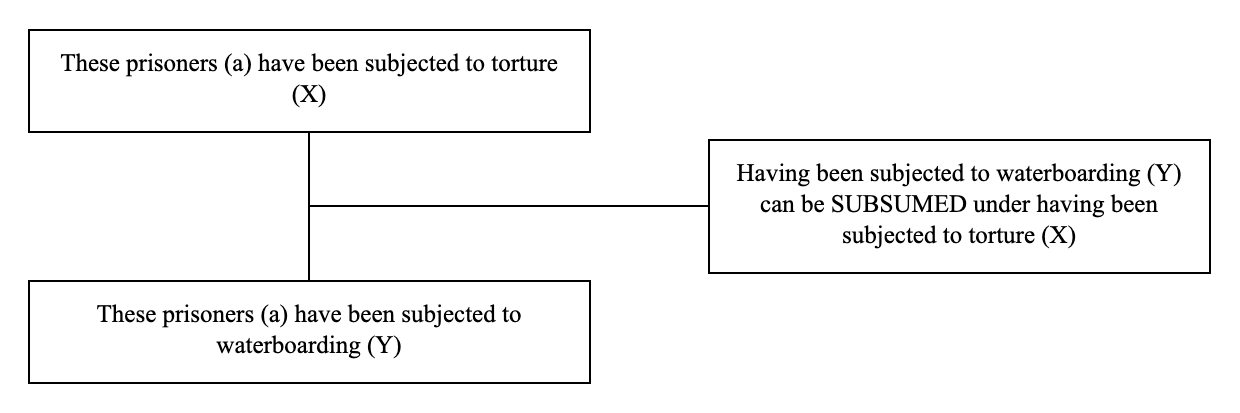
These prisoners (a) have been subjected to torture (X) because these prisoners (a) have been subjected to waterboarding (Y).
Transformations applied: anaphora resolved — “they” replaced by “these prisoners”.
Classification
The subject is the same in both statements and the predicates differ, so the argument form is alpha (a is X because a is Y).
The conclusion “have been subjected to torture” is a statement of value (V) and the premise “have been subjected to waterboarding” is a statement of fact (F), so the argument substance is VF.
The keyword SUBSUMPTION describes the relationship between predicates Y and X. The argument lever can thus be formulated as “Having been subjected to waterboarding (Y) can be SUBSUMED under having been subjected to torture (X)”.
Assessment questions
- Have these prisoners indeed been subjected to waterboarding?
- Does waterboarding fall under torture — is it one of the practices the term covers?
- Is the fact that they were waterboarded enough to conclude that they were tortured, or does the qualification also depend on circumstances the premise leaves out — the legal definition that applies, the intensity and duration of the practice?
Not to be confused with
- Argument from definition — The premise gives the meaning of the term as a whole, not one case that falls under it.
DEFINITION - Argument from criterion — The premise supplies a standard for a judgment of quality.
CRITERION - Argument from instantiation — Substance, not lever: there the premise is itself a verdict rather than a description.
VV
Notes
“These prisoners have been subjected to torture” is a statement of value (V), as “torture” is a legal qualification. Depending on context, one could argue that “having been subjected to waterboarding” is also a statement of value (V).
Source of the example
Source not yet recorded.

