A claim is backed by saying how many people accept it. The argument works because the number of voices is meant to do the work: no one in particular is named, and nothing is offered about what any of them knows. You can attack it by pointing out that widespread belief is not the same as truth — many people have been wrong together — unless some reason is given why the many should be right about this.

Example
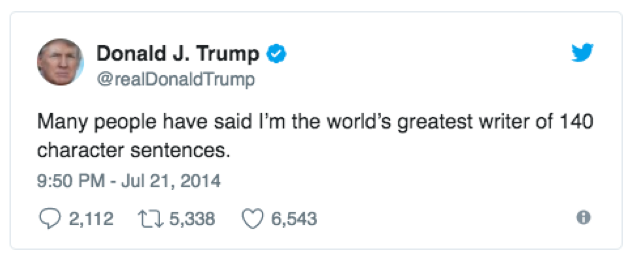
Many people have said I am the world’s greatest writer of 140 character sentences
Standardized form
“I am the world’s greatest writer of 140 character sentences” (q) is acceptable (A) because “I am the world’s greatest writer of 140 character sentences” (q) is said by many people (Z).
Transformations applied: “because” inserted; the source phrase “many people have said” transposed into the premise; the claim’s acceptability made explicit as the conclusion-predicate.
Classification
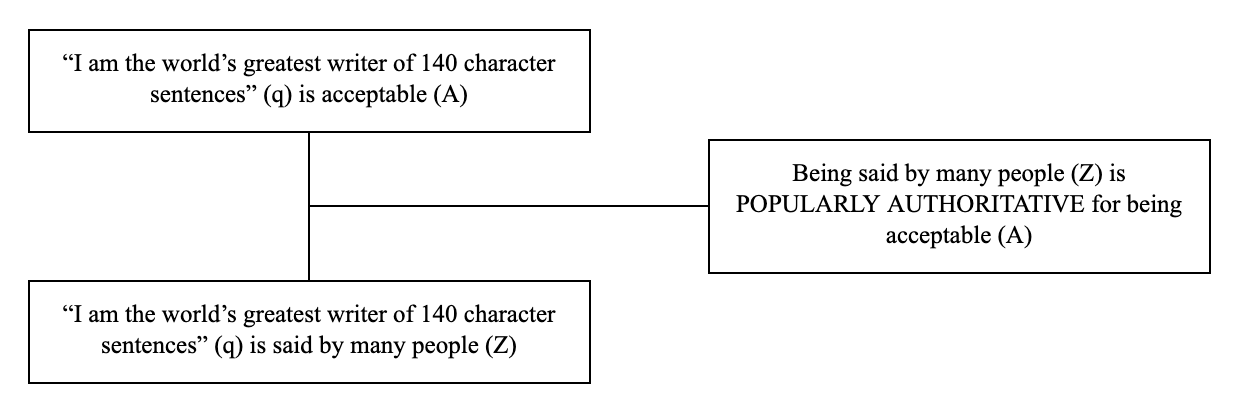
The conclusion is referred to as a whole in the premise, so the argument form is delta (q is A because q is Z).
The premise attributes the conclusion to a third party, so the argument substance is III.
The keyword POPULARLY AUTHORITATIVE describes the relationship between predicates Z and A. The argument lever can thus be formulated as “Being said by many people (Z) is POPULARLY AUTHORITATIVE for being acceptable (A)”.
Assessment questions
- Have many people indeed said that the speaker is the world’s greatest writer of 140 character sentences?
- Is the number of people saying so popularly authoritative on the matter — is there any reason why the many should be right about who writes the best short sentences?
- Is the fact that many people say it enough to accept the claim, or does the absence of any independent standard, or of a comparison with other writers, outweigh it?
Not to be confused with
- Argument from expert opinion — A named source, credited with knowing the subject.
EPISTEMICALLY AUTHORITATIVE - Argument from testimony — A named source, credited with having been in a position to see.
TESTIMONIALLY AUTHORITATIVE - Argument from moral authority — A named source, credited with standing to say what is right.
MORALLY AUTHORITATIVE - Ethotic argument — The arguer offers their own standing rather than other people’s numbers.
I
Notes
Some approaches use the more neutral “argument from the many” as a name for arguments with these characteristics, and reserve “argumentum ad populum” for fallacious instantiations of the type.
See the note on the argument from expert opinion.
Source of the example
A tweet by Donald J. Trump, 24 July 2014.