
The hearer is pressed to accept a claim by being shown what will happen to them if they refuse. The argument works because the harm that follows disagreement gives the hearer a motive to stop objecting, whatever they think of the claim. You can attack it by pointing to the gap between motive and evidence: a threat gives a reason to say yes, but no reason to believe.
Example
We have a right to these territories; our victorious armies will demonstrate this forcefully if you insist upon disputing our rights
Standardized form
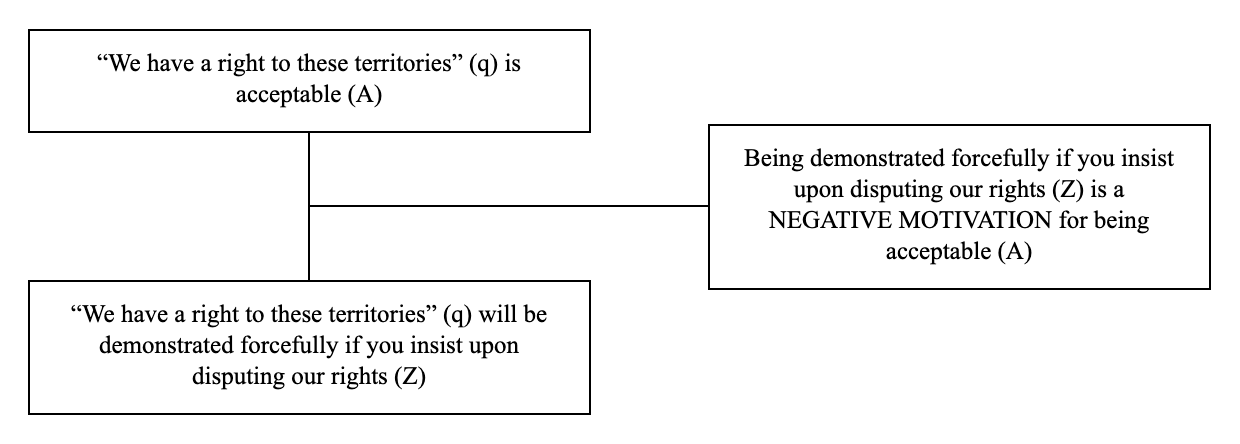
“We have a right to these territories” (q) is acceptable (A) because “we have a right to these territories” (q) will be demonstrated forcefully if you insist upon disputing our rights (Z).
Transformations applied: the semicolon replaced by “because”; anaphora resolved — “this” replaced by “we have a right to these territories”; the claim’s acceptability made explicit as the conclusion-predicate.
Classification
The conclusion is referred to as a whole in the premise, so the argument form is delta (q is A because q is Z).
The premise attributes the conclusion to the addressee, so the argument substance is II.
The keyword NEGATIVE MOTIVATION describes the relationship between predicates Z and A. The argument lever can thus be formulated as “Being demonstrated forcefully if you insist upon disputing our rights (Z) is a NEGATIVE MOTIVATION for being acceptable (A)”.
Assessment questions
- Is it true that the armies will demonstrate the claim forcefully if the addressee disputes it — is the threat real?
- Is the threat of force relevant to whether the speakers have a right to the territories — does it give a reason to believe the claim, as opposed to a reason to say that one believes it?
- Is the threat, even if real, enough to accept the claim?
Not to be confused with
- Argumentum ad carotam — The mirror image: a promised benefit instead of a threatened harm.
OFFERED REWARD - Argumentum ad hominem — Also addressed to the second person, but it attacks the claim through the character of its source.
CHARACTERALLY AUTHORITATIVE,U - Ethotic argument — The premise points to the arguer themselves and appeals to their reputation.
I - Argument from expert opinion — The premise names a third party’s knowledge, not a consequence for the hearer.
III
Notes
This argument is also known as the “appeal to the stick”.
Source of the example
Werkmeister (1948, p. 63), quoted in Walton, D.N. (2000), Scare Tactics. Dordrecht: Springer.

