
Something is ruled out by pointing to a second fact about the same thing that cannot hold together with it. The argument works through an unstated rule that the two properties exclude one another, so that establishing the one is enough to deny the other. You can attack it by showing that the two are compatible after all — that the exclusion is only usual, not strict, or that it does not apply in this case.

Example
Peter cannot be the burglar, because he was in Lisbon on the night of the break-in.
Standardized form
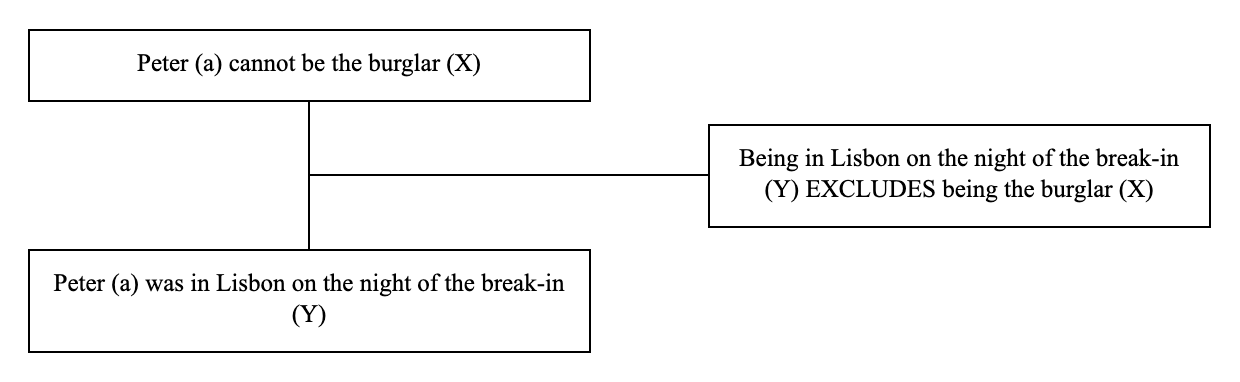
Peter (a) cannot be the burglar (X) because Peter (a) was in Lisbon on the night of the break-in (Y).
Transformations applied: anaphora resolved — “he” replaced by “Peter”.
Classification
The subject is the same in both statements and the predicates differ, so the argument form is alpha (a is X because a is Y).
The conclusion “cannot be the burglar” is a statement of fact (F) and the premise “was in Lisbon on the night of the break-in” is a statement of fact (F), so the argument substance is FF.
The keyword EXCLUDES describes the relationship between predicates Y and X. The argument lever can thus be formulated as “Being in Lisbon on the night of the break-in (Y) EXCLUDES being the burglar (X)”.
Assessment questions
- Was Peter indeed in Lisbon on the night of the break-in?
- Does being in Lisbon on the night of the break-in exclude being the burglar — can the two not both be true?
- Is his being in Lisbon enough to rule Peter out, or might he have been the burglar all the same — by flying back during the night, by using an accomplice, or if the break-in happened at another time than assumed?
Not to be confused with
- Argument from sign — The premise-predicate is a positive indicator of the conclusion-predicate rather than something that rules it out.
SIGN - Argument from cause — The premise names what brought the conclusion about; here it names what makes the conclusion impossible.
CAUSE - Argument from disqualifier — The label is kept and qualified; here the label is withdrawn altogether.
DISQUALIFIER
Notes
The lever of this type is negative: where the argument from sign, cause, effect and correlation all license the presence of the conclusion-predicate, this argument licenses its absence. The classic instance is the alibi. Filing it as an argument from sign with a negated predicate would hide its distinctive point of attack — that the two properties may be compatible after all.
Source of the example
Invented example.

