
An activity is recommended by saying how good, worthwhile, enjoyable, or rewarding it is. The argument works because the value of the activity itself is offered as the reason. You can attack it by disputing the valuation, since the argument reaches only as far as the hearer shares the speaker’s sense of what is worthwhile.
Example
You should do paragliding because it is a great experience
Standardized form
Paragliding (a) should be done by you (X) because paragliding (a) is a great experience (Y).
Transformations applied: subject changed to the activity — “you” replaced by “paragliding”; anaphora resolved — “it” replaced by the same phrase.
Classification
The subject is the same in both statements and the predicates differ, so the argument form is alpha (a is X because a is Y).
The conclusion “should be done by you” is a statement of policy (P) and the premise “is a great experience” is a statement of value (V), so the argument substance is PV.
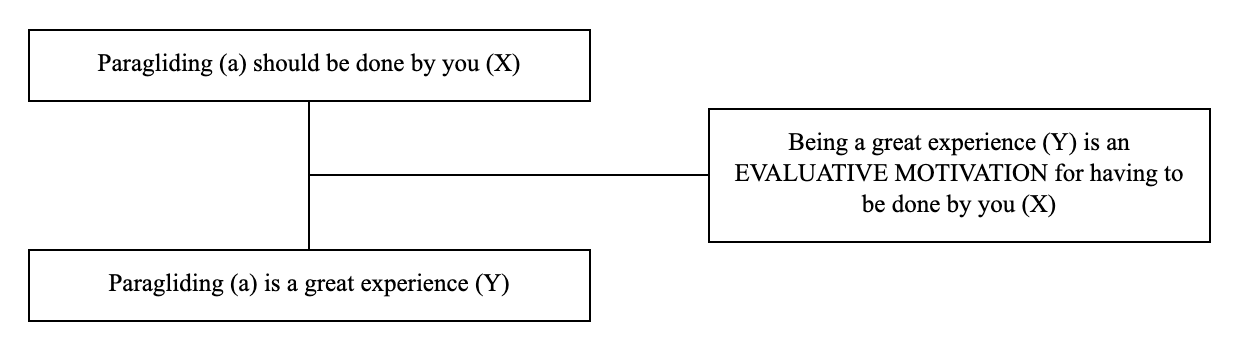
The keyword EVALUATIVE MOTIVATION describes the relationship between predicates Y and X. The argument lever can thus be formulated as “Being a great experience (Y) is an EVALUATIVE MOTIVATION for having to be done by you (X)”.
Assessment questions
- Is paragliding indeed a great experience?
- Is being a great experience a relevant reason for someone to do it — does the value of the activity itself motivate the recommendation?
- Is its being a great experience enough to conclude that you should do paragliding, or are there counter-considerations — risk, cost, fear of heights, the hearer’s own tastes — that outweigh it?
Not to be confused with
- Argument from principle — The premise names a right or a rule at stake rather than the worth of the experience.
PRINCIPLED MOTIVATION - Pragmatic argument — Substance: the premise predicts what the activity will bring about.
PF - Teleologic argument — Substance: the premise names an end the actor is pursuing.
PP - Argument from norm — Substance: the conclusion rates something instead of recommending it.
VV
Source of the example
Review on TripAdvisor by Karanuppal24, 13 December 2017.


