
A description of something is modified by adding a qualification that stops the description from being the whole story. The argument works by conceding the description and denying that it exhausts the case. You can attack it by denying that the qualification makes any real difference, by denying that the case really has it, or by holding that the original description is still the whole story.

Example
History is not just storytelling. It is evidence-based storytelling
Standardized form
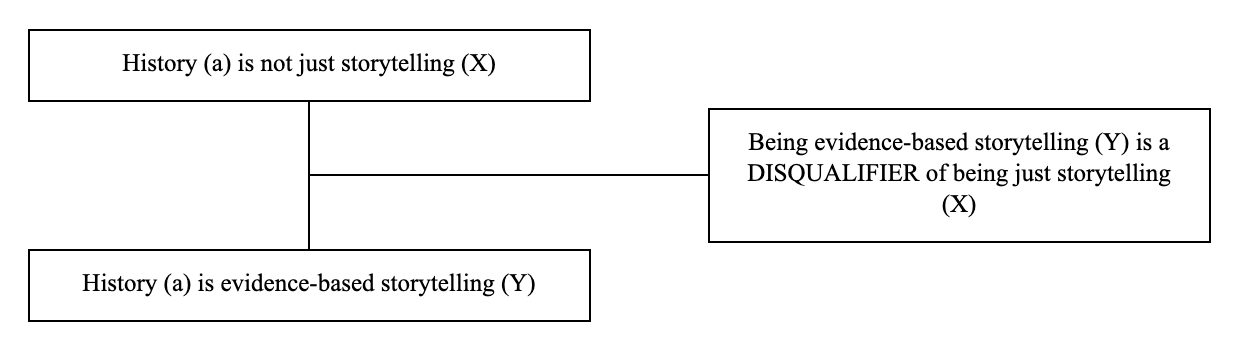
History (a) is not just storytelling (X) because history (a) is evidence-based storytelling (Y).
Transformations applied: “because” inserted, joining the two sentences of the example; anaphora resolved — “it” replaced by “history”.
Classification
The subject is the same in both statements and the predicates differ, so the argument form is alpha (a is X because a is Y).
The conclusion “History is not just storytelling” is a statement of value (V) and the premise “History is evidence-based storytelling” is a statement of value (V), so the argument substance is VV.
The keyword DISQUALIFIER describes the relationship between predicates Y and X. The argument lever can thus be formulated as “Being evidence-based storytelling (Y) is a DISQUALIFIER of being just storytelling (X)”.
Assessment questions
- Is history indeed evidence-based storytelling?
- Does being evidence-based disqualify history from being just storytelling — does the qualification lift it out of the plain category?
- Is the evidence base enough to conclude that history is not just storytelling, or does the narrative form still dominate — in the selection, arrangement and interpretation of the evidence — so that the plain label continues to fit?
Not to be confused with
- Argument from norm — The premise names a standard the subject meets, rather than qualifying a label.
NORM - Argument from instantiation — The premise names a kind of the quality claimed, with no label being taken back.
INSTANTIATION - Argument from definition — Substance, not lever: there the premise is a description, and the label is withheld outright rather than qualified.
VF - Argument from subsumption — Substance: the premise states a matter of fact.
VF
Other examples
- “By using ‘failed state’ (a) I did not mean the accepted international definition of a failed state (X). I meant (a) the weakness in the political system that ethnic origin remains highly determinant in politics (Y).” — Boogaart, R., Jansen, H. & van Leeuwen, M. (2021). “Those are Your Words, Not Mine!” Defence Strategies for Denying Speaker Commitment. Argumentation 35, 209–235. doi:10.1007/s10503-020-09521-3.
Notes
The lever contains the opposite of predicate X because the disqualifier introduces a negation in the conclusion.
Source of the example
Source not yet recorded.

