
The hearer is pressed to accept a claim by being shown what they stand to gain by accepting it. The argument works because the benefit on offer gives the hearer a motive to agree: a carrot (instead of the stick of the argumentum ad baculum). You can attack it by pointing to the gap between motive and evidence, exactly as with the ad baculum: a reward gives a reason to say yes, but no reason to believe.
Example
We have the best offer on this car; agree to it today and I will throw in a free set of winter tires
Standardized form
“We have the best offer on this car” (q) is acceptable (A) because “we have the best offer on this car” (q) will be rewarded with a free set of winter tires if you agree to it today (Z).
Transformations applied: the semicolon replaced by “because”; anaphora resolved — “it” replaced by “we have the best offer on this car”; the imperative “agree to it today” turned into the condition on the premise; the claim’s acceptability made explicit as the conclusion-predicate.
Classification
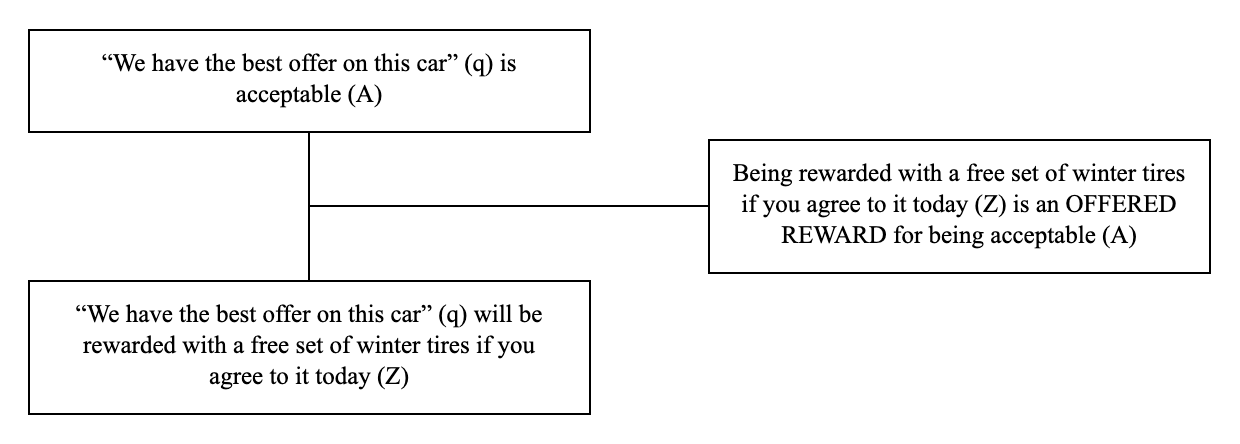
The conclusion is referred to as a whole in the premise, so the argument form is delta (q is A because q is Z).
The premise attributes the conclusion to the addressee, so the argument substance is II.
The keyword OFFERED REWARD describes the relationship between predicates Z and A. The argument lever can thus be formulated as “Being rewarded with a free set of winter tires if you agree to it today (Z) is an OFFERED REWARD for being acceptable (A)”.
Assessment questions
- Is it true that a free set of winter tires will be thrown in if the buyer agrees today — is the reward real?
- Is the offered reward relevant to whether this is the best offer on the car — does it give a reason to believe the claim, as opposed to a reason to accept the deal?
- Is the reward, even if real, enough to accept that this is the best offer, or does that claim need to be checked against what other dealers offer?
Not to be confused with
- Argumentum ad baculum — The mirror image: a threatened harm instead of a promised benefit.
NEGATIVE MOTIVATION - Argumentum ad hominem — Also addressed to the second person, but it attacks the claim through the character of its source.
CHARACTERALLY AUTHORITATIVE,U - Teleologic argument — Form, not lever: there the good consequences follow from doing the thing and here from accepting the claim.
alpha - Argument from expert opinion — The premise names a third party’s knowledge, not a benefit for the hearer.
III
Notes
The argumentum ad carotam is the mirror image of the argumentum ad baculum: the two types share form, substance, and shape, and differ only in whether the consequence held out to the hearer is a benefit or a harm. “Carota” is Latin for carrot, and the pair is the familiar carrot and stick.
Source of the example
Invented example.

