
Most people are familiar with the Periodic Table of Elements, the chart that arranges all the building blocks of matter into a single, elegant framework. What if we could create something similar for arguments?
The Periodic Table of Arguments (PTA) is designed with precisely this aim in mind. It maps out the many ways people try to persuade each other, offering a clear overview of the basic building blocks of everyday reasoning. The PTA is inspired by a long intellectual tradition, comprising the classical disciplines of logic (the art of reasoning), dialectic (the art of debate), and rhetoric (the art of public speech).
What makes the PTA unique is how it blends these three perspectives into a coherent framework. Think of it as an atlas of persuasion. It charts different kinds of arguments, common fallacies, and persuasive strategies across four distinct regions, each with its own mode of reasoning and other characteristic features.
By exploring the PTA, you can quickly understand what kind of argument you’re looking at, how it relates to similar types, and where it fits in the broader landscape of persuasion. Whether you’re a student, a professional, or simply curious about how people convince each other, the PTA offers a helpful way to make sense of the arguments we encounter every day.
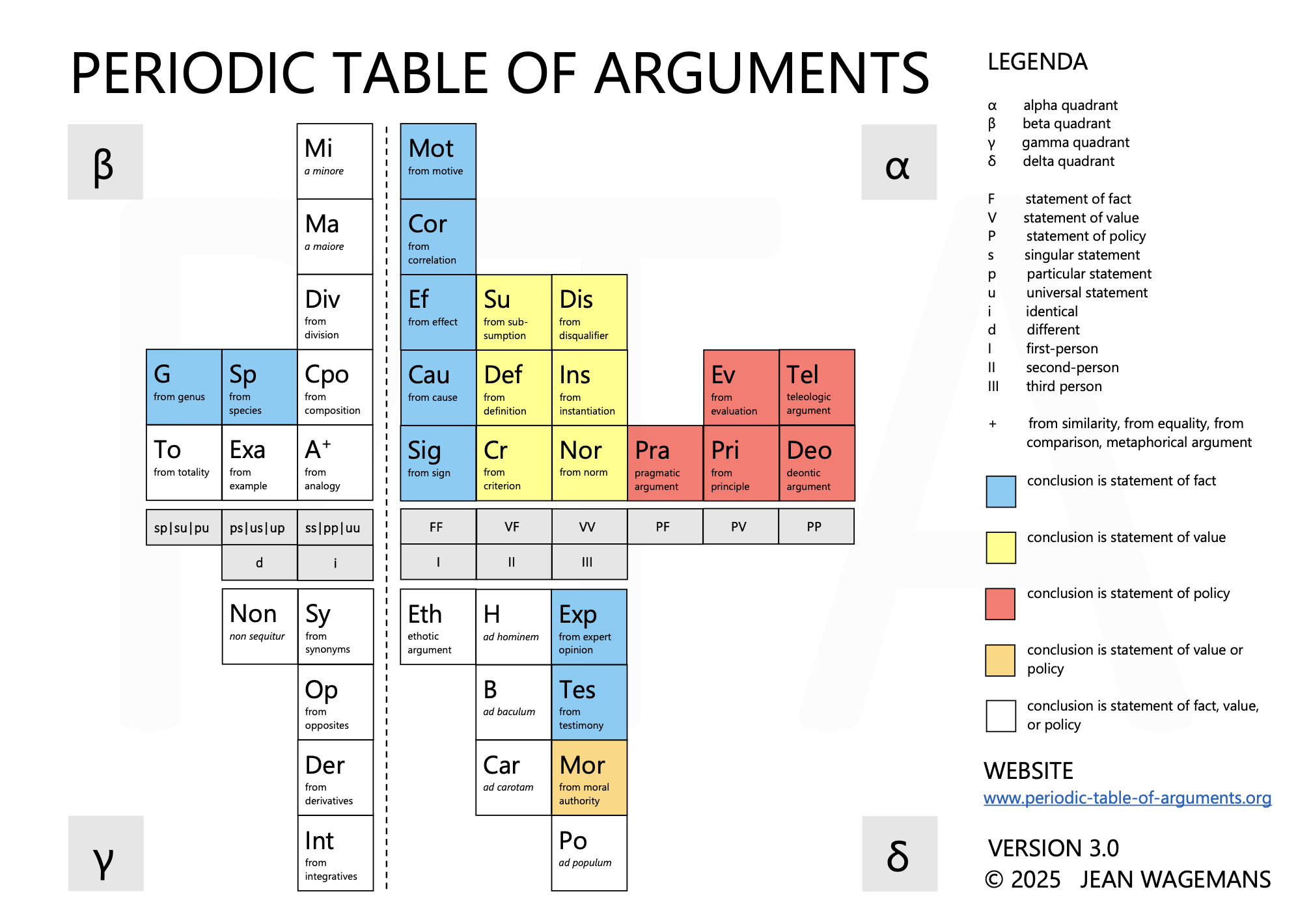
You can explore the PTA by visiting the pages dedicated to the arguments in the Alpha Quadrant, the Beta Quadrant, the Gamma Quadrant, and the Delta Quadrant.
For detailed guidelines for identifying the type of any given argument, please consult the Argument Type Identification Procedure (ATIP) (Wagemans, 2025). Other pages on this website include a general explanation, an alphabetical list of argument types, an explanation of the theoretical framework of the table, and an overview of associated research projects.
For downloads of academic papers about the PTA, including earlier versions of the framework, please visit the sidebar on the right or refer to these pages on Academia.edu.
 PERIODIC TABLE OF ARGUMENTS