
A claim about what ought to be done is backed by who says so, and the person named is someone whose business it is to say what is right — a religious leader, a court, an elder. The argument works because it is their standing to judge, not their information, that is meant to settle the matter. You can attack it by refusing to recognize that standing, since the argument reaches only those who do.
Example
According to the pope, rich countries ought to take in more refugees
Standardized form
“Rich countries ought to take in more refugees” (q) is acceptable (A) because “rich countries ought to take in more refugees” (q) is said by the pope (Z).
Transformations applied: “because” inserted; the source phrase “according to the pope” transposed into the premise; the claim’s acceptability made explicit as the conclusion-predicate.
Classification
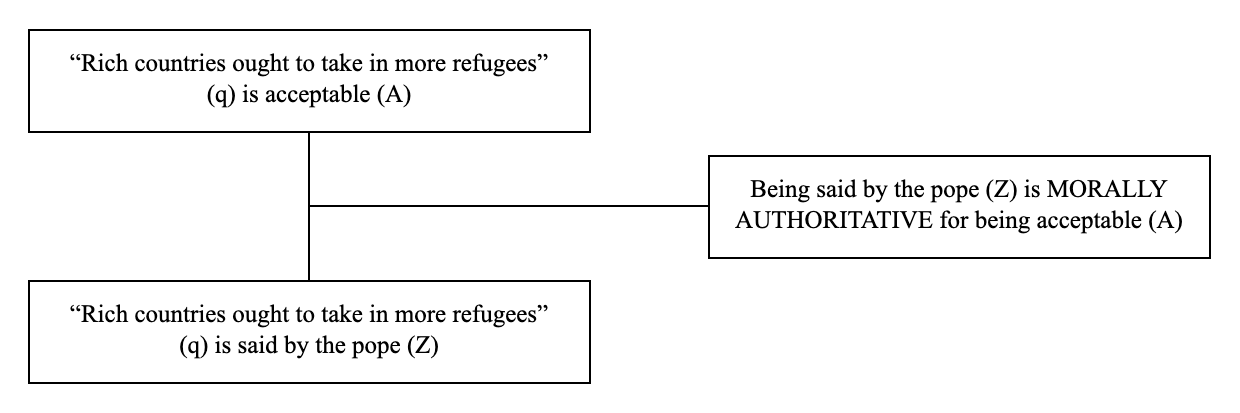
The conclusion is referred to as a whole in the premise, so the argument form is delta (q is A because q is Z).
The premise attributes the conclusion to a third party, so the argument substance is III.
The keyword MORALLY AUTHORITATIVE describes the relationship between predicates Z and A. The argument lever can thus be formulated as “Being said by the pope (Z) is MORALLY AUTHORITATIVE for being acceptable (A)”.
Assessment questions
- Did the pope indeed say that rich countries ought to take in more refugees?
- Is the pope a moral authority on what rich countries owe to refugees — does his standing to judge extend to this question and to this audience?
- Is the pope’s saying it enough to accept the claim, or should it be weighed against the arguments themselves and against the views of other moral authorities, given that moral standing does not settle a policy question on its own?
Not to be confused with
- Argument from expert opinion — The source is credited with knowing the subject rather than with standing to judge it.
EPISTEMICALLY AUTHORITATIVE - Argument from testimony — The source is credited with having been in a position to see.
TESTIMONIALLY AUTHORITATIVE - Argumentum ad populum — Authority is quantitative: how many say it, not who.
POPULARLY AUTHORITATIVE - Ethotic argument — The arguer offers their own standing rather than a third party’s.
I
Notes
See the note on the argument from expert opinion.
Source of the example
Invented example.

