
Something is judged good or bad by pointing to a feature. The argument works by treating that feature as a yardstick: the feature is a plain matter of description, and the verdict follows once the yardstick is accepted. You can attack it by accepting the feature but rejecting the yardstick: this, the critic says, is simply not what quality consists in.
Example
Morandi’s paintings are great because they are not realistic representations of bottles
Standardized form
Morandi’s paintings (a) are great (X) because Morandi’s paintings (a) are not realistic representations of bottles (Y).
Transformations applied: anaphora resolved — “they” replaced by “Morandi’s paintings”.
Classification
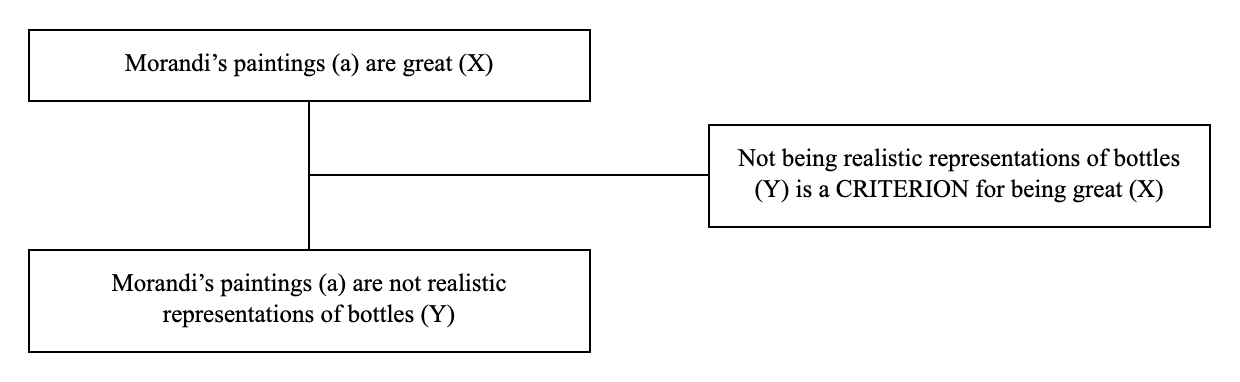
The subject is the same in both statements and the predicates differ, so the argument form is alpha (a is X because a is Y).
The conclusion “are great” is a statement of value (V) and the premise “are not realistic representations of bottles” is a statement of fact (F), so the argument substance is VF.
The keyword CRITERION describes the relationship between predicates Y and X. The argument lever can thus be formulated as “Not being realistic representations of bottles (Y) is a CRITERION for being great (X)”.
Assessment questions
- Are Morandi’s paintings indeed not realistic representations of bottles?
- Is not being a realistic representation a criterion for greatness in painting — a yardstick a critic should accept?
- Is this one feature enough to conclude that the paintings are great, or must other criteria — composition, color, originality — be met as well, and could the same feature count against a painting on a different standard?
Not to be confused with
- Argument from definition — The premise states what the word in the conclusion means, rather than a standard for applying a verdict.
DEFINITION - Argument from subsumption — The premise names a case that falls under the term in the conclusion.
SUBSUMPTION - Argument from norm — Substance, not lever: the premise is itself a verdict rather than a description.
VV - Argument from sign — Substance: the conclusion states a fact rather than passing judgment.
FF
Other examples
- “Anger (a) is less dangerous than indifference (X) because anger (a) can at times be creative (Y).” — Elie Wiesel, “The Perils of Indifference”; americanrhetoric.com.
- “Torture (a) simply does not work (X) because torture (a) consistently produces false confessions and unreliable or misleading information (Y).” — OHCHR press release, January 2017.
Source of the example
Adapted from a discussion on Reddit, r/ContemporaryArt: “Please could someone explain to me why Giorgio…”.


