
A claim about a whole class is supported by pointing to one kind within it. The argument works by carrying what holds of that kind up to the class — unlike an argument from example, the support is not a single individual but a sub-group, humans, say, as one kind of animal. You can attack it by showing that the chosen kind is exactly the one least fit to speak for the rest.
Example
All animals are able to feel pain because humans are able to feel pain
Standardized form
All animals (a) are able to feel pain (X) because humans (b) are able to feel pain (X).
Transformations applied: none — the example is already in canonical form.
Classification
The subjects differ and the predicate is the same, so the argument form is beta (a is X because b is X).
The conclusion is about all animals (u) and the premise about some of the animals, namely humans (p), so the argument substance is up.
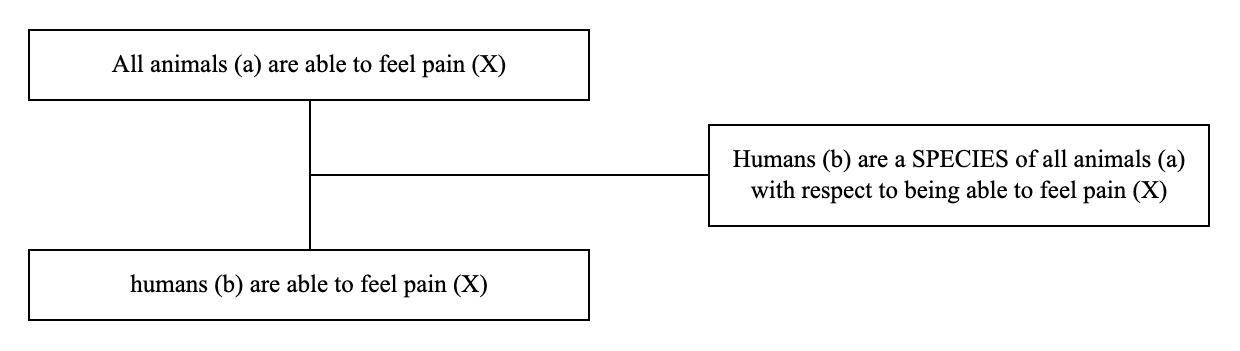
The keyword A SPECIES OF describes the relationship between subjects a and b. The argument lever can thus be formulated as “Humans (b) are a SPECIES of all animals (a) with respect to being able to feel pain (X)”.
Assessment questions
- Are humans indeed able to feel pain?
- Are humans a species of animal in such a way that what holds of humans holds of animals in general?
- Is the human case enough to conclude that all animals can feel pain, or are humans the animals least fit to speak for the rest, so that evidence about other kinds — invertebrates, animals without a central nervous system — is needed?
Not to be confused with
- Argument from example — The premise is a single individual offered as a specimen, not a kind within the class.
us - Argument from genus — Runs the other way, from the wider kind down to the narrower one.
pu - Argument from composition — The premise is the complete set of parts making up the thing in the conclusion, not a kind within a kind.
COMPOSED OF
Notes
Apart from beta form arguments with substance up, those with substance us or ps also fit the scheme, as the scope of the conclusion is broader than that of the premise. Traditionally, the name “argument from species” is reserved for beta form arguments with substance up, us or ps that have statements of fact (F) as their conclusion and premise. Otherwise the name “argument from example” is more appropriate.
Source of the example
Source not yet recorded.

