
A claim is supported by asserting a stripped version of it. The argument works because claim and support are the same statement in two shapes, one wrapped and the other bare. You can attack it by showing that the wrapping isn’t neutral but changes what the terms pick out, so what was true of them on their own stops being true inside the wrapping.
Example
Eating the Minotaur is eating something human, because the Minotaur is human
Standardized form
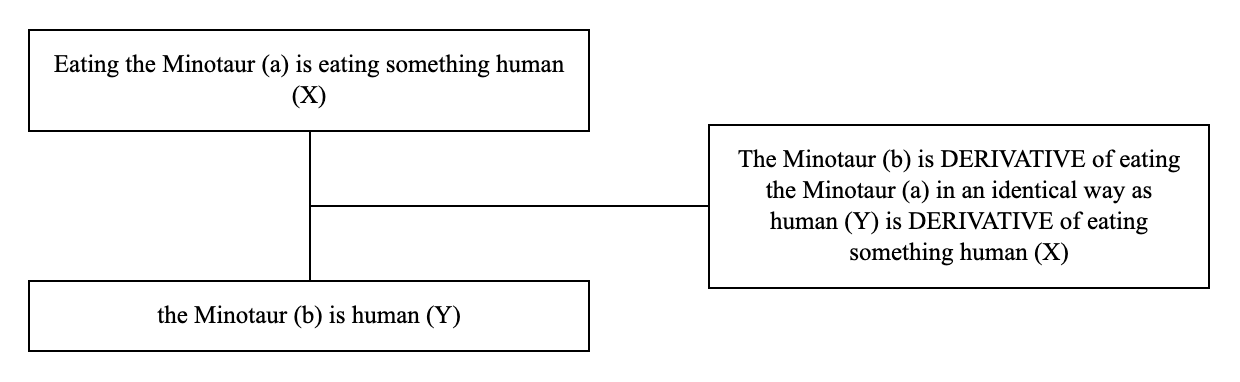
Eating the Minotaur (a) is eating something human (X) because the Minotaur (b) is human (Y).
Transformations applied: none — the example is already in canonical form.
Classification
Both the subjects and the predicates differ, so the argument form is gamma (a is X because b is Y).
The relation between the subjects “eating the Minotaur” and “the Minotaur” matches the relation between the predicates “is eating something human” and “is human”, so the argument substance is i.
The keyword DERIVATIVE describes the relation that the subjects and the predicates both instantiate. The argument lever can thus be formulated as “The Minotaur (b) is DERIVATIVE of eating the Minotaur (a) in an identical way as human (Y) is DERIVATIVE of eating something human (X)”.
Assessment questions
- Is the Minotaur indeed human?
- Is “the Minotaur” derivative of “eating the Minotaur” in the same way as “human” is derivative of “eating something human” — do the bare terms stand to the wrapped ones in one and the same relation?
- Is the Minotaur’s being human enough to conclude that eating the Minotaur is eating something human, or does the wrapping change what the terms pick out — for instance, if the Minotaur is only partly human, so that eating it is not, or not entirely, eating something human?
Not to be confused with
- Argument from synonyms — The matching relation is sameness of meaning.
SYNONYMOUS - Argument from opposites — The matching relation is opposition.
OPPOSITE - Argument from integratives — The relation is part to whole.
INTEGRATIVE - Non sequitur — Substance, not lever: the two relations do not match, so no lever can be formulated.
d
Other examples
- “Ignoring the constitution (a) would be ignoring our foundational beliefs (X) because the constitution (b) forms our foundational beliefs (Y).” — source not yet recorded.
- “Disrespecting art (a) is uncultured (X) because art (b) embodies culture (Y).” — source not yet recorded.
Source of the example
Source not yet recorded.

