
An outcome is noticed and taken to show what must have produced it. The argument works by running a causal rule backwards: this kind of result normally comes from that kind of cause, so the result is taken as evidence that the cause occurred. You can attack it by pointing to another way the same outcome could have come about, since the argument needs the named cause to be the only plausible one.
Example
In the center of Amsterdam, parking rates must have gone up because there are more empty spaces on the streets
Standardized form
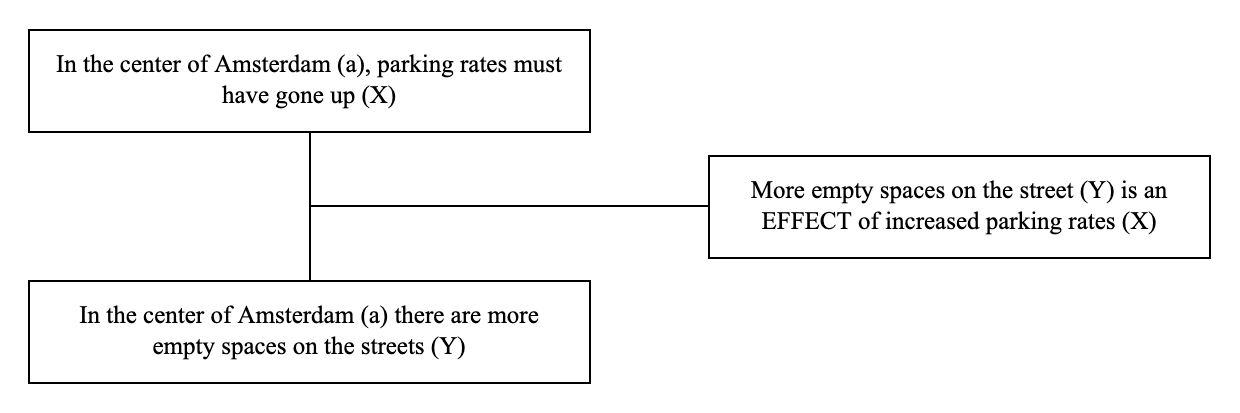
In the center of Amsterdam (a), parking rates must have gone up (X) because in the center of Amsterdam (a) there are more empty spaces on the streets (Y).
Transformations applied: anaphora resolved — “there” replaced by “in the center of Amsterdam”.
Classification
The subject is the same in both statements and the predicates differ, so the argument form is alpha (a is X because a is Y).
The conclusion “parking rates must have gone up” is a statement of fact (F) and the premise “there are more empty spaces on the streets” is a statement of fact (F), so the argument substance is FF.
The keyword EFFECT describes the relationship between predicates Y and X. The argument lever can thus be formulated as “More empty spaces on the street (Y) is an EFFECT of increased parking rates (X)”.
Assessment questions
- Are there indeed more empty spaces on the streets in the center of Amsterdam?
- Is an increase in empty parking spaces a plausible effect of increased parking rates?
- Given that it is, is the increase in empty spaces enough to conclude that the rates have gone up, or are there other plausible causes, such as fewer visitors or better public transport?
Not to be confused with
- Argument from cause — The premise names what produced the state in the conclusion, not what that state produced.
CAUSE - Argument from sign — The premise names a mark that goes with the conclusion without being produced by it.
SIGN - Argument from correlation — No direction of production is claimed at all.
CORRELATION - Argument from motive — The producer is an agent’s reason for acting rather than a process.
MOTIVE
Source of the example
Invented example.

