
The reasoning runs downward from a whole to its parts: what is true of the whole is claimed for each part in it. The argument works by treating each part as sharing the character of the whole. You can attack it by showing that a whole can be excellent overall while one of its parts is weak, or that a part can lack a quality the whole owes to the rest of its parts.

Example
All the faculties of the University of Amsterdam are excellent because the University of Amsterdam is excellent
Standardized form
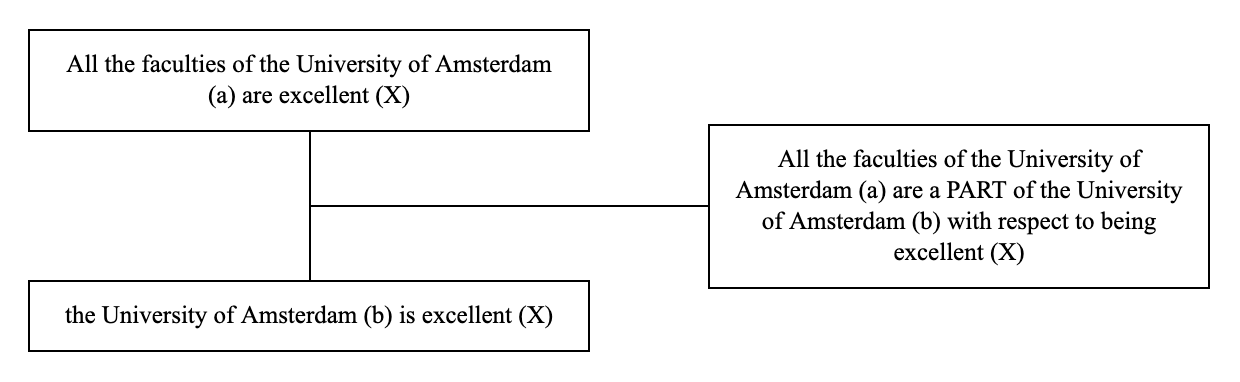
All the faculties of the University of Amsterdam (a) are excellent (X) because the University of Amsterdam (b) is excellent (X).
Transformations applied: none — the example is already in canonical form.
Classification
The subjects differ and the predicate is the same, so the argument form is beta (a is X because b is X).
The conclusion is about all the faculties of the university (u) and the premise about all the faculties making up the university (u), so the argument substance is uu.
The keyword A PART OF describes the relationship between subjects a and b. The argument lever can thus be formulated as “All the faculties of the University of Amsterdam (a) are a PART of the University of Amsterdam (b) with respect to being excellent (X)”.
Assessment questions
- Is the University of Amsterdam indeed excellent?
- Are the faculties parts of the university in such a way that the university’s excellence is found in each of them — is excellence a quality that passes from the whole to its parts?
- Is the university’s excellence enough to conclude that all its faculties are excellent, or can an institution be excellent overall while one faculty is weak, so that each faculty must be judged on its own?
Not to be confused with
- Argument from composition — The same relationship run the other way, from the parts up to the whole.
COMPOSED OF - Argument from totality — The conclusion is one member of the collection, not the complete set of parts.
su - Argument from genus — The premise is a wider kind and the conclusion a narrower kind, not a thing and its components.
BELONGS TO THE GENUS OF
Notes
One could argue that “the University of Amsterdam” is a singular statement (s). In the context of the argument it is a cognitive shorthand for “all the faculties of the University of Amsterdam”, so the subject type is universal (u). See also the argument from composition. One could imagine a similar type with a particular statement (p) as conclusion: “Most of the faculties of the University of Amsterdam are excellent (p) because the University of Amsterdam is excellent (u)”. Since the substance is pu, that type belongs to a different group of the Beta Quadrant.
Source of the example
Invented example.

