
Something is argued to be the case by pointing to a telltale mark that usually goes with it. The argument works because the mark tends to appear when the claim is true, so seeing the one lets you infer the other, even though the mark did not bring the situation about. You can attack it by showing that the mark is not distinctive — that many other things leave the same trace, so it points to nothing in particular.
Example
This movie must have been directed by Christopher Nolan because it has a non-linear plot
Standardized form
This movie (a) must have been directed by Christopher Nolan (X) because this movie (a) has a non-linear plot (Y).
Transformations applied: anaphora resolved — “it” replaced by “this movie”.
Classification
The subject is the same in both statements and the predicates differ, so the argument form is alpha (a is X because a is Y).
The conclusion “must have been directed by Christopher Nolan” is a statement of fact (F) and the premise “has a non-linear plot” is a statement of fact (F), so the argument substance is FF.
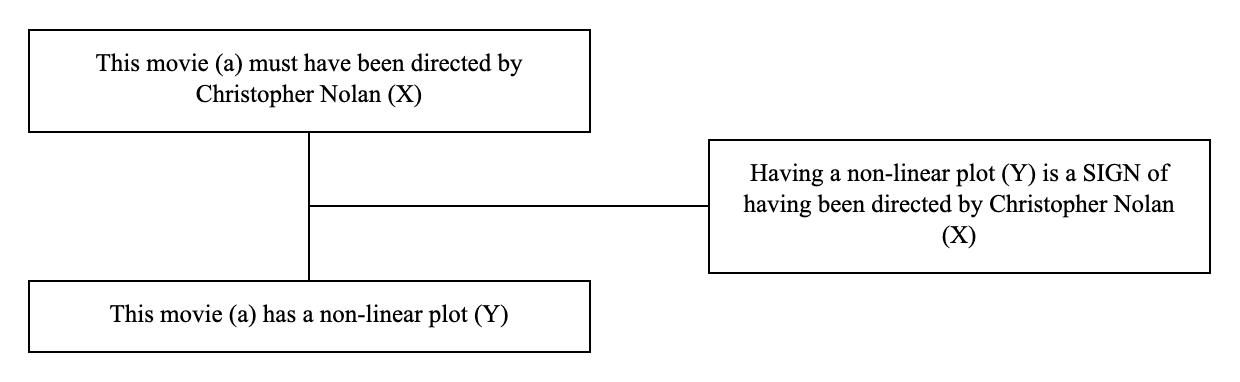
The keyword SIGN describes the relationship between predicates Y and X. The argument lever can thus be formulated as “Having a non-linear plot (Y) is a SIGN of having been directed by Christopher Nolan (X)”.
Assessment questions
- Does this movie indeed have a non-linear plot?
- Is a non-linear plot a reliable sign of a film having been directed by Christopher Nolan — does it tend to appear when, and mainly when, Nolan directed?
- Is the non-linear plot enough to conclude that Nolan directed the film, or do enough other directors scramble chronology that further marks — cast, visual style, the credits — are needed?
Not to be confused with
- Argument from cause — The premise names what produced the state in the conclusion, rather than a mark of it.
CAUSE - Argument from effect — The premise names what the state in the conclusion produced.
EFFECT - Argument from correlation — The two features are merely found together; neither is offered as an indicator of the other.
CORRELATION - Argument from criterion — Substance, not lever: the conclusion is a verdict rather than a matter of fact.
VF
Other examples
- “She (a) must admire Patricia (X) because she (a) is looking at her all the time (Y).” — invented example.
- “You (a) probably eat too much fruit (X) because you (a) are frequently bloated (Y).” — lilynicholsrdn.com, “5 signs you’re eating too much fruit”.
- “This mushroom (a) is poisonous (X) because this mushroom (a) has white gills (Y).” — invented example.
- “All human beings (a) by nature desire to know (X), because all human beings (a) have a liking for their senses (Y).” — Aristotle, Metaphysica 980a21–27, trans. T. Irwin and G. Fine (1995), Aristotle: Selections, Indianapolis: Hackett.
Source of the example
Invented example.

