Whether a label applies to something is decided by spelling out what the label means and checking the case against it. The argument works because a definition sets the conditions for using a word: if the case meets them, it gets the name, and if it does not, the name is withheld. You can attack it by disputing the definition offered, arguing that it is not what the word means, or that it does not capture everything the word means.
Example
Unauthorized downloading is not theft because unauthorized downloading does not deprive the original owner of the use of an object
Standardized form
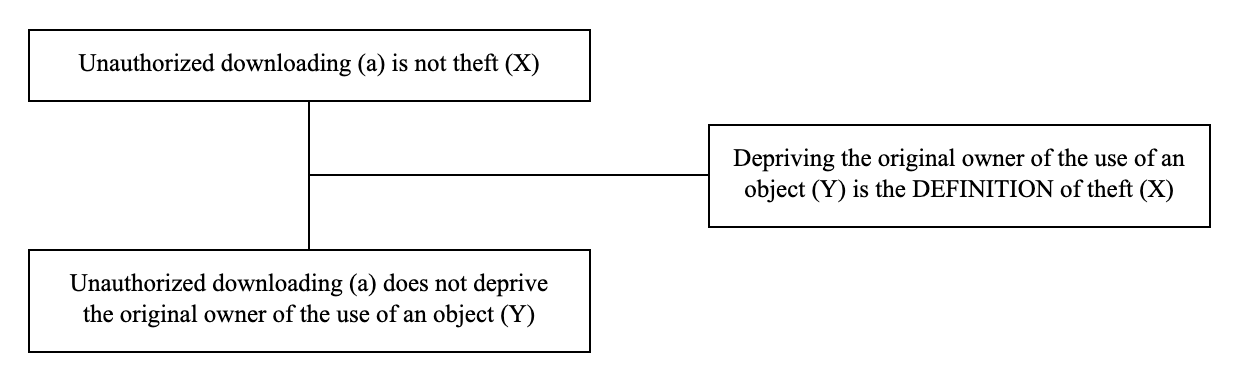
Unauthorized downloading (a) is not theft (X) because unauthorized downloading (a) does not deprive the original owner of the use of an object (Y).
Transformations applied: none — the example is already in canonical form.
Classification
The subject is the same in both statements and the predicates differ, so the argument form is alpha (a is X because a is Y).
The conclusion “is not theft” is a statement of value (V) and the premise “does not deprive the original owner of the use of an object” is a statement of fact (F), so the argument substance is VF.
The keyword DEFINITION describes the relationship between predicates Y and X. The argument lever can thus be formulated as “Depriving the original owner of the use of an object (Y) is the DEFINITION of theft (X)”.
Assessment questions
- Is it true that unauthorized downloading does not deprive the original owner of the use of an object?
- Is depriving the owner of the use of an object what defines theft — is this what the word means, and all that it means?
- Is not depriving the owner of use enough to conclude that downloading is not theft, or does a wider definition of theft — taking what is not yours to take, including lost income or rights — still capture it?
Not to be confused with
- Argument from criterion — The premise supplies a standard for a judgment of quality, not the meaning of the term in the conclusion.
CRITERION - Argument from subsumption — The premise names a particular case that falls under the term instead of spelling the term out.
SUBSUMPTION - Argument from disqualifier — Substance, not lever: the premise is itself evaluative, and it qualifies the label rather than withholding it.
VV
Other examples
- “The author of this blog post (a) committed plagiarism (X) because the author of this blog post (a) presented another person’s work as their own (Y).” Source not yet recorded.
Source of the example
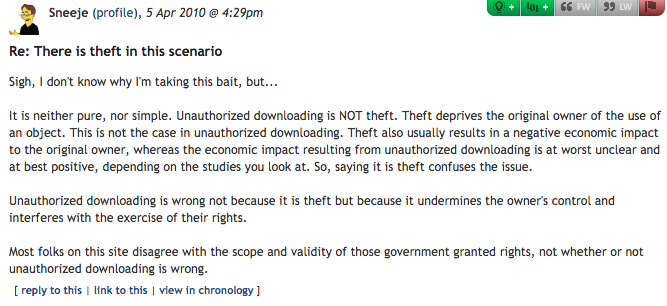
Comment on an article published on techdirt.com, 05.04.2010.