
The argument runs from the greater case to the lesser one: if something holds even where it is hardest to believe — of the strongest, the wisest, the most exalted, the nearest relation — then it surely holds of the ordinary case. The argument works because the two cases are placed on one scale, so that whatever is granted at the top must be granted below it. You can attack it by denying the scale, since without it there is no reason why what holds of the one case should hold of the other.
Example
Humans don’t know everything because even the gods don’t know everything
Standardized form
Humans (a) don’t know everything (X) because even the gods (b) don’t know everything (X).
Transformations applied: none — the example is already in canonical form.
Classification
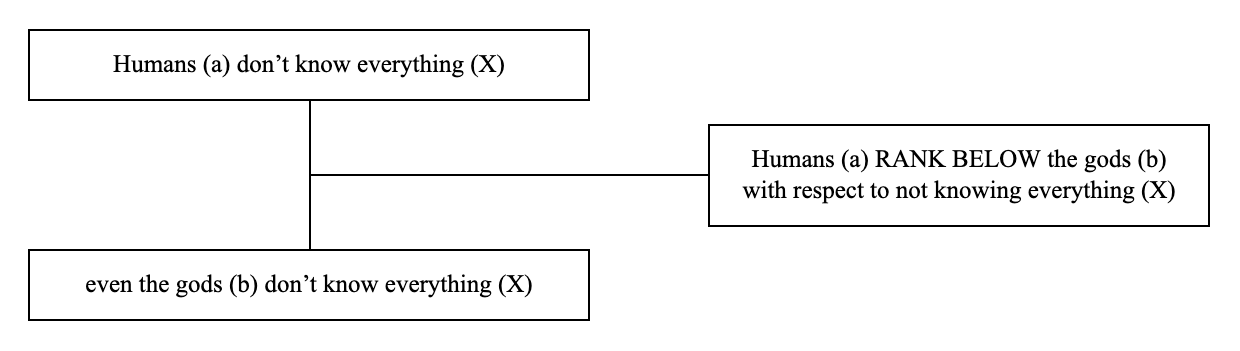
The subjects differ and the predicate is the same, so the argument form is beta (a is X because b is X).
The conclusion is about all humans (u) and the premise about all the gods (u), so the argument substance is uu.
The keyword RANKS BELOW describes the relationship between subjects a and b: on the scale that underlies the predicate — here, knowledge — the subject of the conclusion is the lesser case and the subject of the premise the greater one. The argument lever can thus be formulated as “Humans (a) RANK BELOW the gods (b) with respect to not knowing everything (X)”.
Assessment questions
- Is it acceptable that even the gods don’t know everything?
- Do humans rank below the gods on the scale of knowledge — is there one scale on which both cases can be placed?
- Is the gods’ not knowing everything enough to conclude that humans don’t know everything, or does the argument carry nothing for a hearer who rejects the scale — who does not accept the gods, or denies that divine and human knowledge are commensurable?
Not to be confused with
- Argumentum a minore — The mirror image: the subject of the conclusion is the greater case and the subject of the premise the lesser one, so the argument runs up the scale instead of down it.
RANKS ABOVE - Argument from example — The premise is a specimen of the class in the conclusion, not a case ranked above it.
AN EXAMPLE OF - Argument from analogy — The two cases are held to be alike, with no ranking between them.
ANALOGOUS
Other examples
- “His neighbor (a) must have been beaten by him (X) because even his father (b) was beaten by him (X).” — source not yet recorded. Substance ss; lever “His neighbor (a) RANKS BELOW his father (b) with respect to having been beaten by him (X)”: beating one’s own father is the graver deed, so whoever did not stop at that will not have stopped at a neighbor.
- “I (a) can’t solve this equation (X) because even Einstein (b) can’t solve this equation (X).” — source not yet recorded. Substance ss; lever “I (a) RANK BELOW Einstein (b) with respect to not being able to solve this equation (X)”.
Notes
The argumentum a maiore and the argumentum a minore share their form (beta) and differ only in the direction of the ranking expressed by the lever. In the argumentum a maiore the predicate is the negative pole of the underlying scale (not knowing everything, not being able to solve the equation), or the graver instance of a deed, so it carries downward from the greater case to the lesser one; in the argumentum a minore the predicate is the positive pole, so it carries upward from the lesser case to the greater one.
Like the argumentum a minore, one could argue this is an alpha form argument. The reconstruction would then go: “Not knowing everything (a) belongs to humans (X) because not knowing everything (a) belongs to the gods (Y)”, with the lever “belonging to the gods (Y) is LESS PROBABLE than belonging to humans (X)”. The other examples reconstruct as: “He (a) has beaten his neighbor (X) because he (a) has beaten his father (Y)”, with the lever “having beaten his father (Y) is LESS PROBABLE than having beaten his neighbor (X)”; and “Solving this equation (a) can’t be done by me (X) because solving this equation (a) can’t be done by Einstein (Y)”, with the lever “can’t be done by Einstein (Y) is LESS PROBABLE than can’t be done by me (X)”.
Source of the example
Source not yet recorded.

