
One party is said to owe a second a certain treatment because the second treated the first that way. The argument works on the rule that what is received should be returned: the earlier act creates a debt, and the debt is offered as the reason for the act now being asked for. You can attack it by denying that the earlier act was owed anything in return, or by showing that the debt has already been paid.
Example
You should back Maria’s proposal, because she backed yours.
Standardized form
You (a) should back the other party’s proposal (X) because Maria (b) backed the other party’s proposal (X).
Transformations applied: anaphora resolved — “she” replaced by “Maria”; the two predicates normalized to the shared predicate “back the other party’s proposal”.
Classification
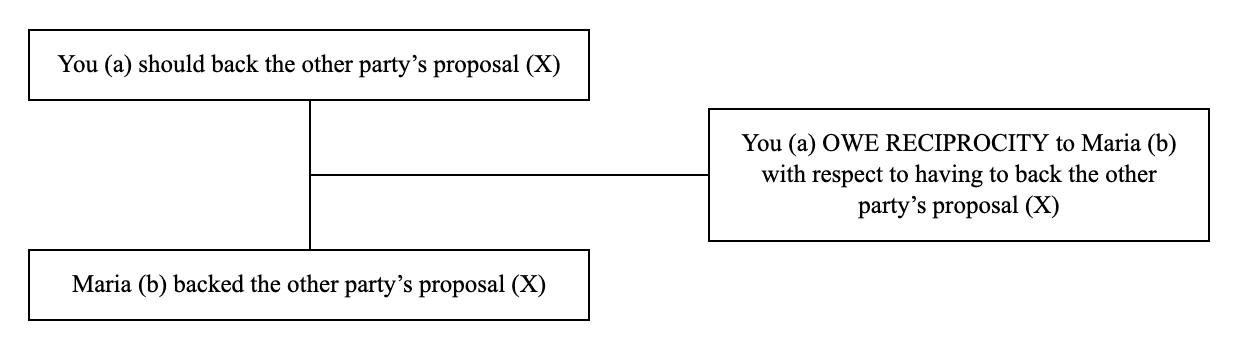
The subjects differ and the predicate is the same, so the argument form is beta (a is X because b is X).
The conclusion is about one specific person (s) and the premise about one specific person (s), so the argument substance is ss.
The keyword OWES RECIPROCITY describes the relationship between subjects a and b. The argument lever can thus be formulated as “You (a) OWE RECIPROCITY to Maria (b) with respect to having to back the other party’s proposal (X)”.
Assessment questions
- Did Maria indeed back your proposal?
- Do you owe Maria reciprocity — did her support create a debt that calls for a return in kind?
- Is her having backed your proposal enough to conclude that you should back hers, or do other considerations outweigh it — the merits of her proposal, whether the debt has already been repaid, whether her support was owed anyway?
Not to be confused with
- Argument from equality — The two parties are to be treated alike by some third party or rule; here the parties are to treat each other alike.
EQUAL - Argument from analogy — The two cases are held to be alike in a relevant respect; here they are not alike but in debt to one another.
ANALOGOUS - Argument from similarity — Both statements are statements of fact rather than a policy claim and a fact.
F ← F
Notes
This type is the argumentative form of the norm of reciprocity studied in sociology and anthropology, and it underlies a large share of everyday bargaining. It is not an argument from equality: the equality argument compares how two parties are treated, whereas this one turns on an exchange between them.
Source of the example
Invented example.

