
A course of action is recommended on the ground that it can now be done. The argument works by letting feasibility stand in for desirability: once the obstacle to doing something is gone, the fact that it is within reach is offered as reason enough to do it. You can attack it by insisting that being able to do something is no reason to do it, or by disputing whether it is really feasible at all.
Example
We should send astronauts to Mars, because we now have the technology to get them there.
Standardized form
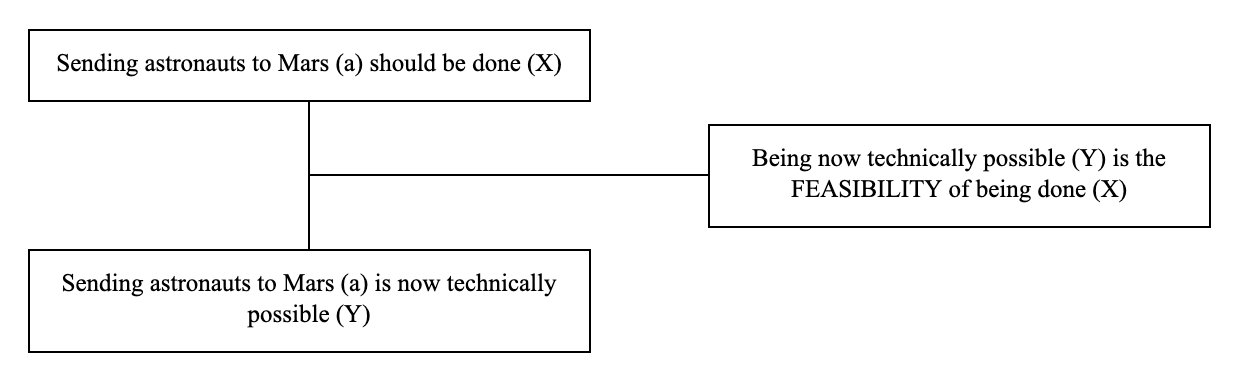
Sending astronauts to Mars (a) should be done (X) because sending astronauts to Mars (a) is now technically possible (Y).
Transformations applied: the sentence recast so that the course of action is the subject of both statements; “we have the technology to get them there” rendered as “is now technically possible”.
Classification
The subject is the same in both statements and the predicates differ, so the argument form is alpha (a is X because a is Y).
The conclusion “should be done” is a statement of policy (P) and the premise “is now technically possible” is a statement of fact (F), so the argument substance is PF.
The keyword FEASIBILITY describes the relationship between predicates Y and X. The argument lever can thus be formulated as “Being now technically possible (Y) is the FEASIBILITY of being done (X)”.
Assessment questions
- Is sending astronauts to Mars indeed now technically possible?
- Is technical feasibility a relevant reason for doing something — does the fact that an action can be done give a reason to do it?
- Is feasibility enough to conclude that we should send astronauts to Mars, or must the case also address the cost, the risk to the crew and the scientific return, any of which could outweigh it?
Not to be confused with
- Teleologic argument — The action is recommended as a means to a goal; here no goal is named, only the fact that the action is within reach.
TELEOLOGIC MOTIVATION - Pragmatic argument — The action is recommended for what it will bring about, not for being possible.
PRAGMATIC MOTIVATION - Argument from evaluation — Substance, not lever: the premise is a judgment of how worthwhile the action is, not a fact about whether it can be done.
PV
Notes
This type has a widely used negative counterpart — “we should not require it, because it cannot be enforced” — that runs on the same lever in the other direction, following the principle that ought implies can. The negative form is generally regarded as sound; the positive form, in which “can” is taken to yield “ought”, is the more contestable of the two and is therefore the more instructive to display.
Source of the example
Invented example.

