A claim is backed by who made it, and the person named is someone who is supposed to know the subject. The argument works because the expert’s knowledge is offered in place of any argument about the matter itself: if they know, and they say so, that is reason enough. You can attack it by showing that the expertise is not real, not relevant to this particular question, or not shared by others in the field.

Example
We only use 10% of our mental potentials. This was the belief of Albert Einstein, the greatest physicist of recent times.
Standardized form
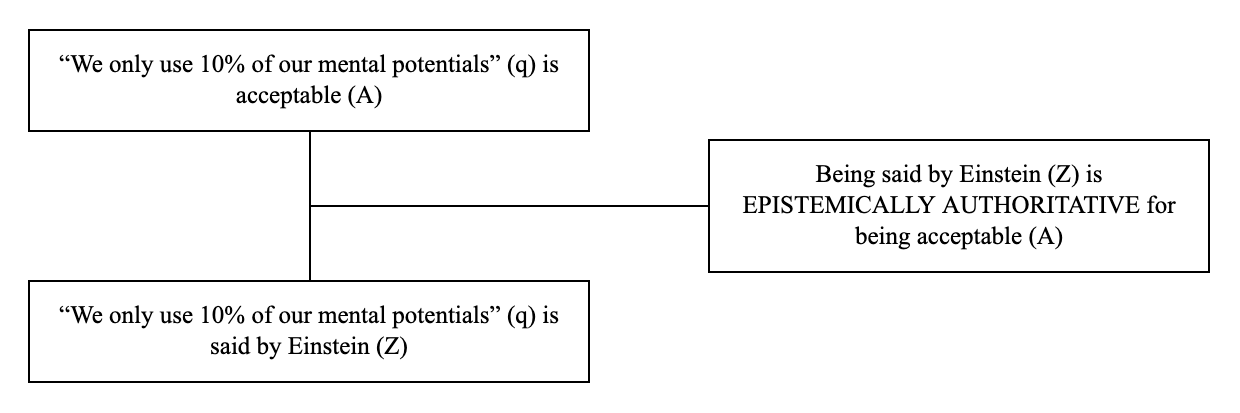
“We only use 10% of our mental potentials” (q) is acceptable (A) because “we only use 10% of our mental potentials” (q) is said by Einstein (Z).
Transformations applied: “because” inserted; the second sentence, which attributes the belief to Albert Einstein, transposed into the premise as “is said by Einstein”; the claim’s acceptability made explicit as the conclusion-predicate.
Classification
The conclusion is referred to as a whole in the premise, so the argument form is delta (q is A because q is Z).
The premise attributes the conclusion to a third party, so the argument substance is III.
The keyword EPISTEMICALLY AUTHORITATIVE describes the relationship between predicates Z and A. The argument lever can thus be formulated as “Being said by Einstein (Z) is EPISTEMICALLY AUTHORITATIVE for being acceptable (A)”.
Assessment questions
- Did Einstein indeed say that we only use 10% of our mental potentials?
- Is Einstein an epistemic authority on the workings of the human mind and its potential?
- Is Einstein’s saying it enough to accept that we only use 10% of our mental potentials, or should it be checked against what experts in the relevant fields — neuroscientists and psychologists — say?
Not to be confused with
- Argument from testimony — The source counts because they were in a position to see, not because of what they know in general.
TESTIMONIALLY AUTHORITATIVE - Argument from moral authority — The source counts because of their standing to say what is right.
MORALLY AUTHORITATIVE - Argumentum ad populum — Authority is quantitative: how many say it, not who.
POPULARLY AUTHORITATIVE - Argumentum ad hominem — The premise points at the addressee and attacks acceptability.
II,U
Notes
The argument from expert opinion, argument from testimony, argument from moral authority, and argumentum ad populum are all specific forms of what is traditionally known as the “argument from authority”. The first three types involve qualitative authority: epistemic authority (someone with the right knowledge), situational authority (someone in a position to know), and deontic authority (someone with proper moral authority). The argumentum ad populum relies on quantitative authority. In practice, mixed variants can occur, such as when an argument is endorsed by “the majority of economic experts in the country”.
Source of the example
A pamphlet reproducing the well-known urban myth that Einstein said we only use 10% of our mental potentials. Einstein said no such thing.