
A present state is explained by pointing to what happened to the thing earlier. The argument works through an unstated rule that this kind of event produces this kind of result, so once the event is granted, the result is expected. You can attack it by showing that the rule has exceptions, or that something intervened and stopped the usual result from occurring.
Example
The students must have come into the classroom soaking wet because they came cycling through the pouring rain
Standardized form
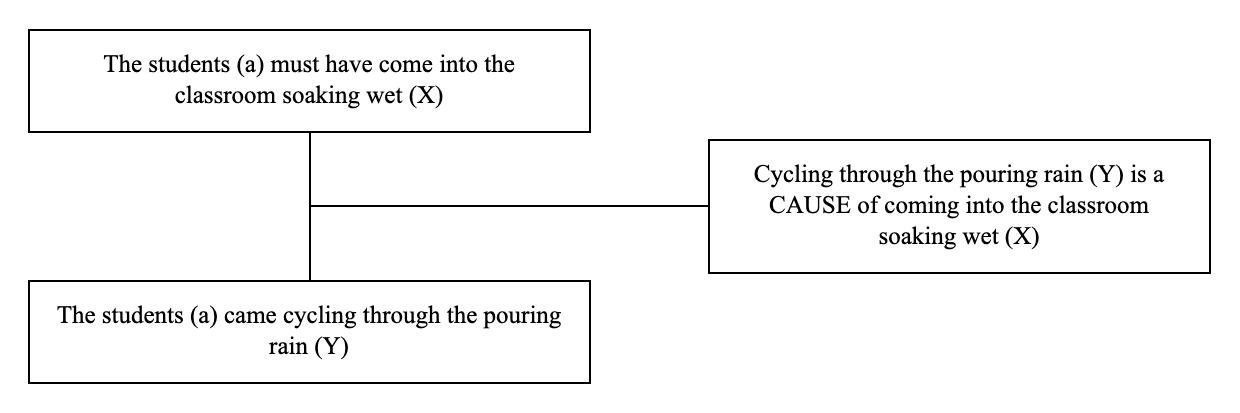
The students (a) must have come into the classroom soaking wet (X) because the students (a) came cycling through the pouring rain (Y).
Transformations applied: anaphora resolved — “they” replaced by “the students”.
Classification
The subject is the same in both statements and the predicates differ, so the argument form is alpha (a is X because a is Y).
The conclusion “must have come into the classroom soaking wet” is a statement of fact (F) and the premise “came cycling through the pouring rain” is a statement of fact (F), so the argument substance is FF.
The keyword CAUSE describes the relationship between predicates Y and X. The argument lever can thus be formulated as “Cycling through the pouring rain (Y) is a CAUSE of coming into the classroom soaking wet (X)”.
Assessment questions
- Did the students indeed come cycling through the pouring rain?
- Does cycling through pouring rain cause a person to arrive soaking wet?
- Is their having cycled through the rain enough to conclude that they came in soaking wet, or could something have intervened — rain gear, a very short ride, time to dry off — that stopped the usual result?
Not to be confused with
- Argument from effect — The lever runs the other way: the premise names the result, not what produced it.
EFFECT - Argument from sign — The premise names a reliable mark of the conclusion without producing it.
SIGN - Argument from motive — What produces the state is a person’s reason for acting rather than a physical process.
MOTIVE - Pragmatic argument — Substance, not lever: the conclusion recommends a course of action instead of stating what happened.
PF
Other examples
- “I (a) will make New York safe for everyone (X) because I (a) will tackle the rise of hate crime (Y).” — reconstructed from Zohran Mamdani’s Terminal 5 rally speech, New York, 15 June 2025.
Source of the example
Invented example.

