
One thing is rated by setting it beside another that already carries the rating wanted. The argument works because the second thing is agreed to be excellent or dreadful, and the first is held to belong in the same bracket, so the agreed rating carries over. You can attack it by denying that the two are of a kind, which rejects the argument without disputing anything about the second thing.
Example
The Jane must be an excellent restaurant because Oud Sluis is an excellent restaurant
Standardized form
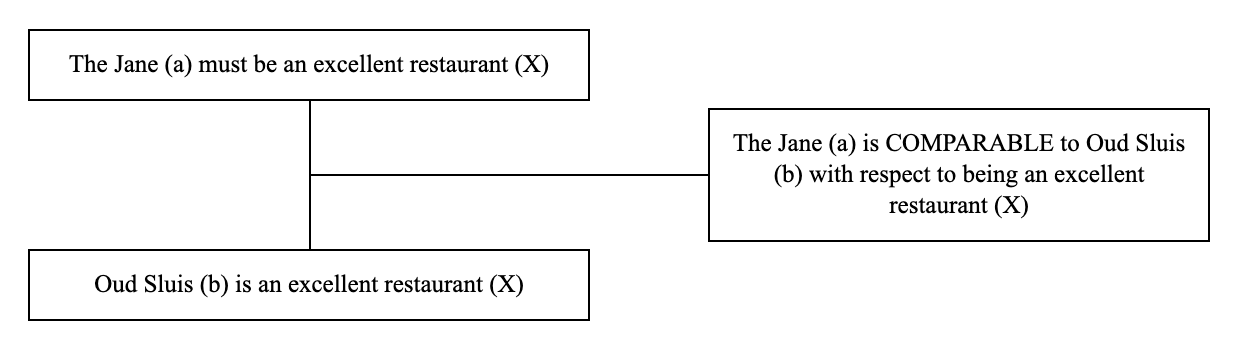
The Jane (a) must be an excellent restaurant (X) because Oud Sluis (b) is an excellent restaurant (X).
Transformations applied: none — the example is already in canonical form.
Classification
The subjects differ and the predicate is the same, so the argument form is beta (a is X because b is X).
The conclusion is about one specific restaurant (s) and the premise about one specific restaurant (s), so the argument substance is ss.
The keyword COMPARABLE describes the relationship between subjects a and b. The argument lever can thus be formulated as “The Jane (a) is COMPARABLE to Oud Sluis (b) with respect to being an excellent restaurant (X)”.
Assessment questions
- Is Oud Sluis indeed an excellent restaurant?
- Is The Jane comparable to Oud Sluis in the respects that make a restaurant excellent — chef, kitchen, standards?
- Is Oud Sluis’s excellence enough to conclude that The Jane is excellent, or does a verdict on one restaurant not simply carry over to another, so that evidence about The Jane itself — reviews, awards, a visit — is required?
Not to be confused with
- Argument from similarity — What is transferred is something that happened rather than a judgment of quality.
F ← F - Argument from equality — What is transferred is an entitlement, and the premise remains factual.
P ← F - Argument from analogy — The likeness is one of relations: elements of the one case stand to each other as elements of the other case do, rather than the two cases being measurable by the same standard.
ANALOGOUS - Metaphoric argument — The second case is a figure of speech, and the shared verdict is left unstated.
METAPHORICALLY
Other examples

- “It is not best to change the president in wartime (a) because it is not best to swap horses when crossing streams (b).” Adapted from a report of Abraham Lincoln’s reply to the Delegation from the National Union League, 9 June 1864.
- “You (a) will love this book (X). You (a) liked her last one (Y)!”
Notes
In the literature, the argument from comparison is often not distinguished from the argument from analogy. In the PTA the two are distinct types: the argument from comparison transfers an appraisal between two cases that are measured by the same standard, the argument from analogy transfers a predicate on the strength of a correspondence between the relations that hold within each case.
Source of the example
Invented example.

