
One judgment of quality is backed with another. The argument works by treating the supporting quality as a standard: whatever has it counts as good, or bad, in the way claimed. You can attack it by refusing the standard — a hearer who thinks a song can be catchy and still be throwaway will not grant that the one quality settles the other.
Example
This song is awesome because it’s catchy
Standardized form
This song (a) is awesome (X) because this song (a) is catchy (Y).
Transformations applied: anaphora resolved — “it’s” replaced by “this song is”.
Classification
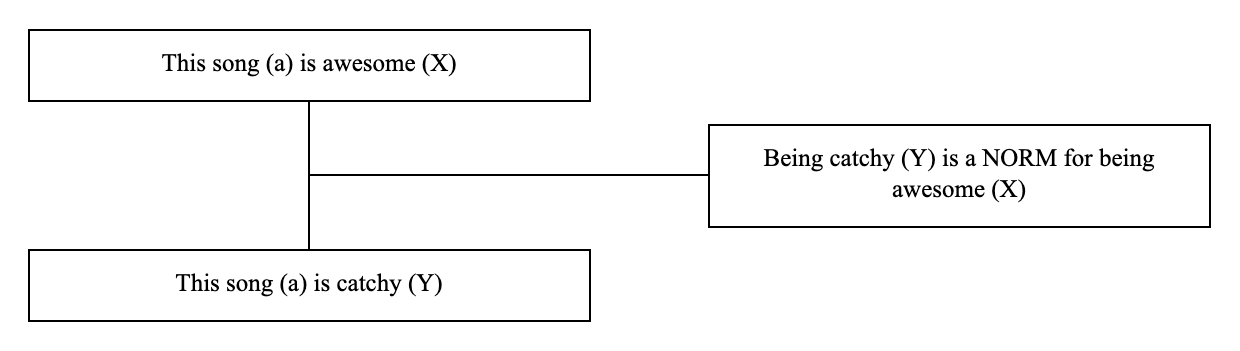
The subject is the same in both statements and the predicates differ, so the argument form is alpha (a is X because a is Y).
The conclusion “is awesome” is a statement of value (V) and the premise “is catchy” is a statement of value (V), so the argument substance is VV.
The keyword NORM describes the relationship between predicates Y and X. The argument lever can thus be formulated as “Being catchy (Y) is a NORM for being awesome (X)”.
Assessment questions
- Is this song indeed catchy?
- Is being catchy a norm for being awesome — a standard by which the quality of a song is measured?
- Is catchiness enough to conclude that the song is awesome, or must it meet further standards — lyrics, musicianship, originality — and can a catchy song still be throwaway?
Not to be confused with
- Argument from criterion — Substance, not lever: there the premise is a description rather than a verdict.
VF - Argument from instantiation — The quality in the premise is a particular case of the one in the conclusion, not a separate standard.
INSTANTIATION - Argument from disqualifier — The premise takes back part of a label the conclusion denies.
DISQUALIFIER - Argument from evaluation — Substance: the conclusion recommends doing something rather than rating it.
PV
Other examples
- “Abandoning a friend in need (a) is wrong (X) because abandoning a friend in need (a) is heartless (Y).” — source not yet recorded.
- “Raising taxes on the poor (a) is unjust (X) because raising taxes on the poor (a) is exploitative (Y).” — source not yet recorded.
Notes
One could argue that this argument type is a variant of the argument from criterion, as the lever can also be formulated with the keyword CRITERION. This would mean that there are two arguments from criterion, one with a statement of fact (F) and another with a statement of value (V) as its premise.
Source of the example
Source not yet recorded.

