
A course of action is argued for or against by predicting what it will lead to. The argument works because a forecast of gain or harm gives a reason to act: if the action brings the good result it should be done, and if it brings the bad one it should not. You can attack it by disputing the forecast, or by insisting that the action should be judged on principle regardless of its results.
Example
The government should not introduce a basic income because that will lead to a drop in income for most people
Standardized form
Introducing a basic income (a) should not be done (X) because introducing a basic income (a) will lead to a drop in income for most people (Y).
Transformations applied: subject changed to the activity — “the government” replaced by “introducing a basic income”; anaphora resolved — “that” replaced by the same phrase.
Classification
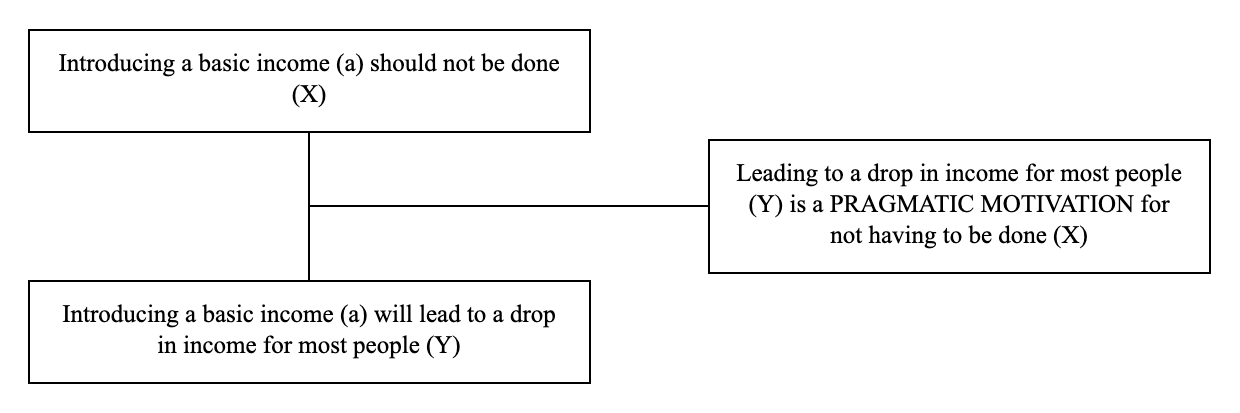
The subject is the same in both statements and the predicates differ, so the argument form is alpha (a is X because a is Y).
The conclusion “should not be done” is a statement of policy (P) and the premise “will lead to a drop in income for most people” is a statement of fact (F), so the argument substance is PF.
The keyword PRAGMATIC MOTIVATION describes the relationship between predicates Y and X. The argument lever can thus be formulated as “Leading to a drop in income for most people (Y) is a PRAGMATIC MOTIVATION for not having to be done (X)”.
Assessment questions
- Would introducing a basic income indeed lead to a drop in income for most people?
- Is a drop in income for most people a relevant consequence for deciding whether to introduce a basic income?
- Is this consequence, on its own, a sufficient reason not to introduce it, or are there advantages — simplicity, security, reduced poverty — that outweigh it?
Not to be confused with
- Argument from principle — Substance: the premise passes a moral verdict on the measure instead of predicting its results.
PV - Argument from evaluation — Substance: the premise rates the activity rather than forecasting what it will bring.
PV - Deontic argument — Substance: the premise states another obligation.
PP - Teleologic argument — Substance: the premise states an end the actor pursues.
PP
Other examples
- “Children (a) should sleep without a light on (X), because that (a) prevents them from ruining their eyesight (Y).” — presented by Martijn Demollin at the VIOT 2018 Conference, based on Quinn et al. (1999), Nature 399, 113–114; BBC News, Health, 12 May 1999.
Notes
In reconstructing arguments with a statement of policy (P) in the conclusion, it is often helpful to take the activity — in this case, “introducing a basic income” — as the subject.
Source of the example
Source not yet recorded.

