
A permission, an entitlement or an obligation is claimed for one party on the ground that another party already has it or takes it. The argument rests on the rule that like cases should be treated alike, so what the other party does or gets becomes what the first party may or should do. You can attack it by showing that the two parties are not owed the same treatment, so that what holds for the one need not hold for the other.
Example
Dutch royals should pay taxes because every other citizen pays taxes
Standardized form
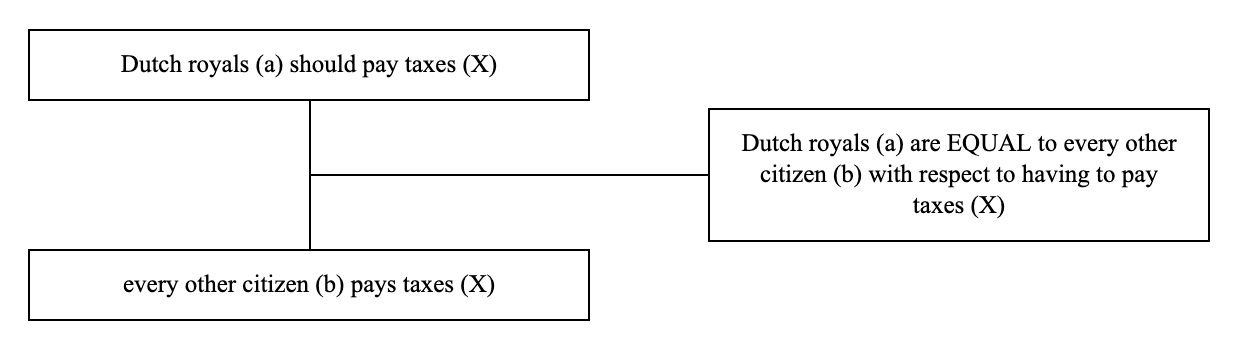
Dutch royals (a) should pay taxes (X) because every other citizen (b) pays taxes (X).
Transformations applied: none — the example is already in canonical form.
Classification
The subjects differ and the predicate is the same, so the argument form is beta (a is X because b is X).
The conclusion is about all Dutch royals (u) and the premise about all other citizens (u), so the argument substance is uu.
The keyword EQUAL describes the relationship between subjects a and b. The argument lever can thus be formulated as “Dutch royals (a) are EQUAL to every other citizen (b) with respect to having to pay taxes (X)”.
Assessment questions
- Does every other citizen indeed pay taxes?
- Are the Dutch royals equal to every other citizen in the respects that matter for taxation — are the two owed the same treatment?
- Is the fact that every other citizen pays taxes enough to conclude that the royals should pay too, or are there relevant differences — their constitutional position, the way their office is funded — that would justify an exception?
Not to be confused with
- Argument from comparison — What is transferred is a judgment of quality rather than a permission.
V ← V - Argument from similarity — Both halves report how things stand; nothing is being recommended.
F ← F - Argument from analogy — The likeness is one of relations: elements of the one case stand to each other as elements of the other case do, rather than the two cases having the same normative standing.
ANALOGOUS - Argument from totality — The premise class is one the conclusion’s subject belongs to, not a separate party held to be its equal.
BELONGS TO THE TOTALITY OF
Other examples
- “You (a) should not stop buying guns (X) because criminals (b) have not stopped buying guns (X).” — source not yet recorded.
- “Emma (a) should have a salary raise (X) because Peter (b) had a salary raise (X).” — source not yet recorded.
Notes
In the literature, the argument from equality is often not distinguished from the argument from analogy. In the PTA the two are distinct types: the argument from equality transfers an entitlement between two cases that have the same normative standing, the argument from analogy transfers a predicate on the strength of a correspondence between the relations that hold within each case.
Source of the example
From a news item on a poll by the Dutch television program EenVandaag, in which 62 percent of Dutch people said King Willem-Alexander, Queen Máxima and Princess Beatrix should pay taxes like every other citizen.

