
A claim about one kind of thing is supported by pointing to the wider kind it falls under. The argument works by passing down what is said of the wider class to the narrower one: birds have emotions because all animals do. You can attack it by showing that the property does not belong to the wider class as such — to every member, because it is a member — but only to most of them as it happens.

Example
Birds have emotions because all animals have emotions
Standardized form
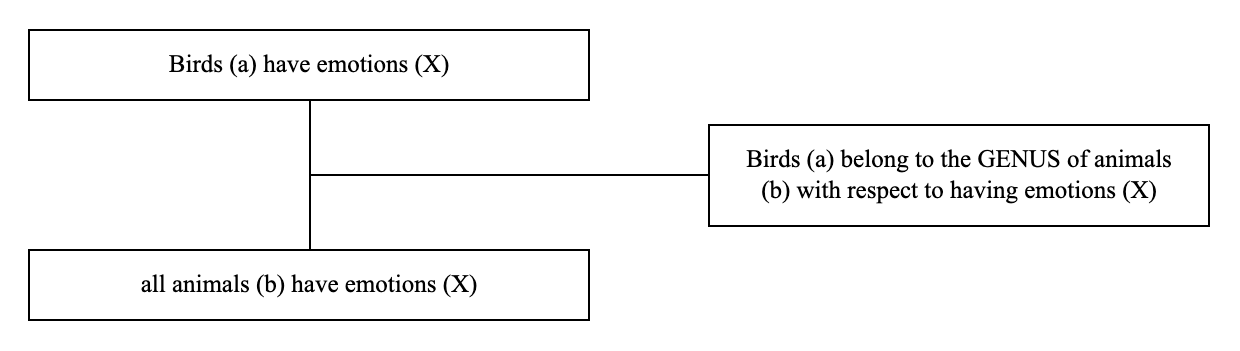
Birds (a) have emotions (X) because all animals (b) have emotions (X).
Transformations applied: none — the example is already in canonical form.
Classification
The subjects differ and the predicate is the same, so the argument form is beta (a is X because b is X).
The conclusion is about some of the animals, namely birds (p), and the premise about all animals (u), so the argument substance is pu.
The keyword BELONGS TO THE GENUS OF describes the relationship between subjects a and b. The argument lever can thus be formulated as “Birds (a) belong to the GENUS of animals (b) with respect to having emotions (X)”.
Assessment questions
- Do all animals indeed have emotions?
- Do birds belong to the genus of animals — are they a kind within the wider class?
- Is the general claim about animals enough to conclude that birds have emotions, or does having emotions belong only to most animals as it happens rather than to every member as such, so that the claim about birds needs support of its own?
Not to be confused with
- Argument from totality — The conclusion is one individual member of the collection, not a kind within it.
su - Argument from species — Runs the other way, from the narrower kind up to the wider one.
up - Argument from division — The premise and conclusion are a thing and its components, not a wider kind and a narrower one.
A PART OF
Notes
Apart from beta form arguments with substance pu, those with substance su or sp also fit the scheme, as the scope of the conclusion is smaller than that of the premise. Different from “argument from totality”, which is an appropriate name for any beta form argument with substance su, sp or pu, in the tradition the name “argument from genus” is reserved for arguments with factual predicates (F).
Source of the example
Source not yet recorded.

