
Something is claimed about one case by pointing to a second, different case about which the same thing is already accepted. The argument works because the two cases are alike in the respect that matters here, so what holds for one carries over to the other. You can attack it by denying that the cases are alike in the way the claim requires, which collapses the argument without disputing anything about the second case.
Example
The impact of a large asteroid darkened the earth for several years, because the eruption of Krakatoa in 1883 darkened the earth for over two years
Standardized form
The asteroid impact (a) darkened the earth for years (X) because the Krakatoa eruption (b) darkened the earth for years (X).
Transformations applied: the two durations (“several years”, “over two years”) generalized to the shared predicate “for years”; the subjects shortened to the two events.
Classification
The subjects differ and the predicate is the same, so the argument form is beta (a is X because b is X).
The conclusion is about one specific event (s) and the premise about one specific event (s), so the argument substance is ss.
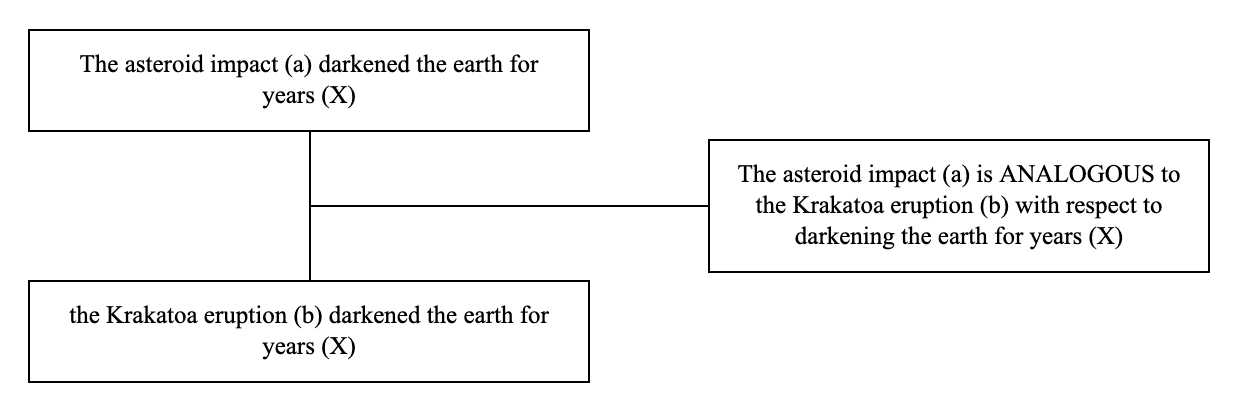
The keyword ANALOGOUS describes the relationship between subjects a and b. The argument lever can thus be formulated as “The asteroid impact (a) is ANALOGOUS to the Krakatoa eruption (b) with respect to darkening the earth for years (X)”.
Assessment questions
- Did the Krakatoa eruption indeed darken the earth for years, i.e., did its dust stay in the stratosphere for two to three years and attenuate sunlight worldwide?
- Is the asteroid impact analogous to the Krakatoa eruption in the respect that matters — an explosion injecting fine material into the stratosphere — rather than merely in both producing dust?
- Is the Krakatoa case enough to conclude that the impact darkened the earth for years, given the roughly thousandfold difference in scale and the different nature of the ejected material?
Not to be confused with
- Argument from similarity — Substance in the alpha sense: a factual claim supported by a factual one.
F ← F - Argument from comparison — An evaluation supported by an evaluation.
V ← V - Argument from equality — A policy claim supported by a factual one.
P ← F - Argument from example — Substance, not lever: the conclusion is about a whole class and the premise about one member of it.
us
Other examples
- “Cycling on the grass (a) is prohibited (X) because walking on the grass (b) is prohibited (X).” — Kolb, R. (2016). The law of treaties: An introduction (p. 152). Cheltenham: Edward Elgar Publishing.
Notes
In the PTA, “analogy” names a relation between relations: a and b need not resemble each other, provided that elements of a stand to each other as elements of b stand to each other. This is what distinguishes the argument from analogy from its neighbors in the Beta Quadrant, which transfer the predicate on the strength of shared properties (similarity), the same normative standing (equality), measurability by the same standard (comparison), or a figurative identification (metaphor). The example shows the relational lever at work: an eruption and an impact differ in kind and in scale, but the impact stands to the pulverized rock it ejects as the eruption stands to its ash. Both the premise and the lever are supported in the source. The premise rests on an argument from cause (the eruption injected some 4 km³ of fine material into the stratosphere, which caused the worldwide attenuation of sunlight visible in the brilliant sunsets of the following years), and the lever on an argument from definition (standing to its ejecta as the eruption stands to its ash — an explosion injecting fine material into the stratosphere — is what being analogous to the eruption consists in). The best-known objection to the hypothesis, Kent’s (1981) observation that the far larger eruption of Toba caused no mass extinction, is not an objection to the analogy at all: it accepts that the impact darkened the earth and attacks the further argument from cause, from darkness to extinction, that takes the conclusion of the analogy as its premise.
Source of the example
Alvarez, L.W., Alvarez, W., Asaro, F., & Michel, H.V. (1980). Extraterrestrial cause for the Cretaceous-Tertiary extinction. Science, 208(4448), 1095–1108 (p. 1105). Discussed in Shelley, C. (2004). Analogy counterarguments: A taxonomy for critical thinking. Argumentation, 18(2), 223–238.

