
What someone has said is rejected by pointing at the person who said it. The argument works on the assumption that who makes a claim settles whether it is true, so the speaker’s character, situation or conduct is offered as reason enough to dismiss the claim without examining it. You can attack it by observing that a claim can be correct whoever happens to make it.
Example
Your claim that everyone should become a vegetarian makes no sense. You work at a seafood restaurant!
Standardized form
“Everyone should become a vegetarian” (q) is unacceptable (U) because “everyone should become a vegetarian” (q) is said by you (Z).
Transformations applied: “because” inserted between the two sentences; “your claim that everyone should become a vegetarian” resolved into the quoted proposition; the claim’s unacceptability made explicit as the conclusion-predicate; the second sentence set aside as support for the lever, see the Notes below.
Classification
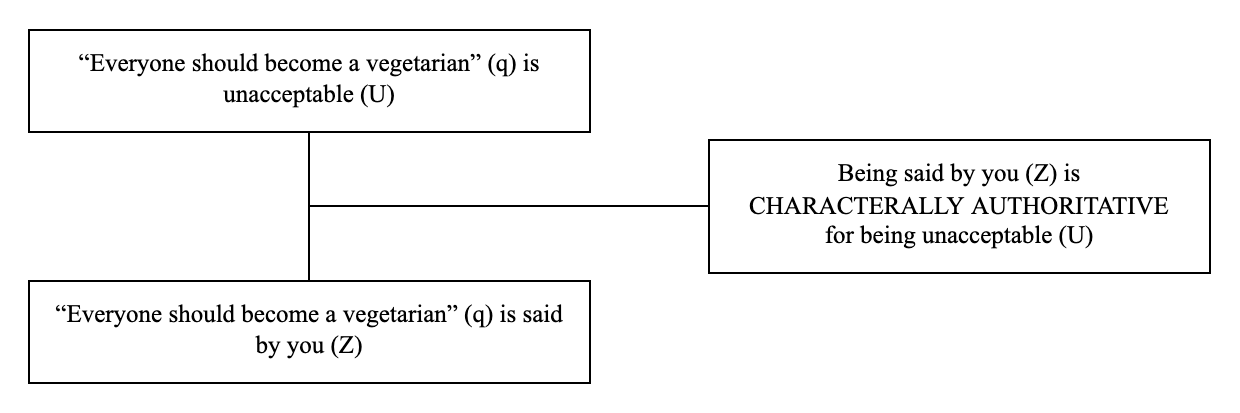
The conclusion is referred to as a whole in the premise, so the argument form is delta (q is U because q is Z).
The premise attributes the conclusion to the addressee, so the argument substance is II.
The keyword CHARACTERALLY AUTHORITATIVE describes the relationship between predicates Z and U. The argument lever can thus be formulated as “Being said by you (Z) is CHARACTERALLY AUTHORITATIVE for being unacceptable (U)”.
Assessment questions
- Is the claim that everyone should become a vegetarian indeed made by you, the person who works at a seafood restaurant?
- Is your working at a seafood restaurant relevant to the acceptability of the claim that everyone should become a vegetarian — does it, for instance, show that you cannot be sincere, or that you have no knowledge of the matter?
- Even if it says something about you, is it enough to reject the claim, given that the claim could be true regardless of who makes it?
Not to be confused with
- Ethotic argument — The premise points at the arguer themselves, and supports acceptability.
I,A - Argumentum ad baculum — Also addressed to the second person, but the premise offers a threatened harm rather than a bad character.
NEGATIVE MOTIVATION - Argumentum ad carotam — Also addressed to the second person, but the premise offers a promised benefit.
OFFERED REWARD - Argument from expert opinion — A third party, and acceptability supported rather than attacked.
III,A
Notes
The second sentence of the example expresses the fact that the source of the claim works in a seafood restaurant, and can be reconstructed as a premise that supports the lever of the original argument: “Being said by you is CHARACTERALLY AUTHORITATIVE for being unacceptable because you work at a seafood restaurant.”
The tradition distinguishes three variants: (1) the direct or abusive ad hominem, which attributes a negative characteristic to the source; (2) the indirect or circumstantial ad hominem, which doubts the source’s motives for endorsing the claim; and (3) the tu quoque, which points out an inconsistency between the source’s behavior and their believing the claim.
While the tradition reserves the label ad hominem for attacks on the other party in the discussion, and thus for the second-person perspective, there is no reason it could not also be used for arguments in which the unacceptability of a claim is supported by attacking a third party. In that case the argumentum ad hominem has substance III and can be interpreted as a negative argument from authority.
Source of the example
Invented example.

