
A claim about something is supported by saying a different thing about one part or aspect of it. The argument works by letting the part settle the whole: how hard a thing is to defeat is treated as deciding whether it will win. You can attack it by denying that the part is decisive for the whole.

Example
Evil will never beat good because defeating evil is easier than defeating good
Standardized form
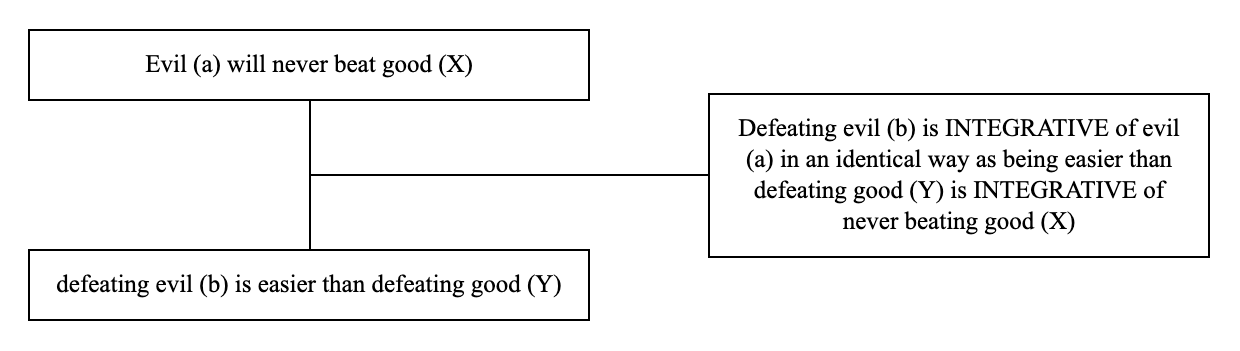
Evil (a) will never beat good (X) because defeating evil (b) is easier than defeating good (Y).
Transformations applied: none — the example is already in canonical form.
Classification
Both the subjects and the predicates differ, so the argument form is gamma (a is X because b is Y).
The relation between the subjects “evil” and “defeating evil” is the same as the relation between the predicates “will never beat good” and “is easier than defeating good”, so the argument substance is i.
The keyword INTEGRATIVE describes the relation that the subjects and the predicates both instantiate. The argument lever can thus be formulated as “Defeating evil (b) is INTEGRATIVE of evil (a) in an identical way as being easier than defeating good (Y) is INTEGRATIVE of never beating good (X)”.
Assessment questions
- Is defeating evil indeed easier than defeating good?
- Is defeating evil an integrative aspect of evil in the same way as being easier to defeat is an integrative aspect of never winning — is the part, in each case, decisive for the whole?
- Is the greater ease of defeating evil enough to conclude that evil will never beat good, or can what is easier to defeat still win — because nobody attempts the defeat, or because the fight is never fought on equal terms?
Not to be confused with
- Argument from synonyms — The matching relation is sameness of meaning.
SYNONYMOUS - Argument from opposites — The matching relation is opposition.
OPPOSITE - Argument from derivatives — One term is formed from the other.
DERIVATIVE - Non sequitur — Substance, not lever: the two relations do not match, so no lever can be formulated.
d
Source of the example
Source not yet recorded.

