
The speaker backs their claim by offering themselves as its guarantee. The argument works because they present themselves as someone whose word counts, so their standing carries the claim in place of anything about the subject matter itself. You can attack it by questioning that standing, or by showing it is irrelevant to the matter at hand.
Example
In this book, I say that the late Prince Bernhard had a third extramarital daughter, and I have built a good reputation when it comes to royal revelations
Standardized form
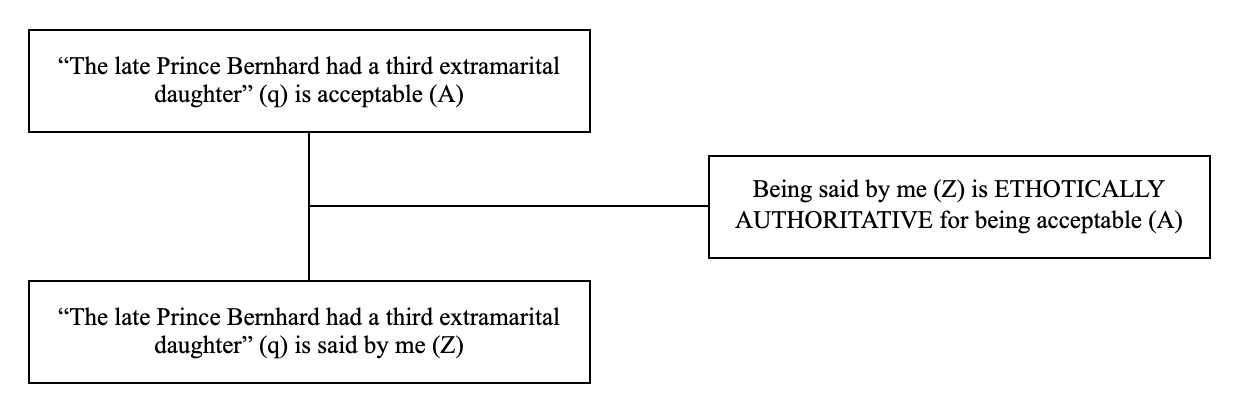
“The late Prince Bernhard had a third extramarital daughter” (q) is acceptable (A) because “the late Prince Bernhard had a third extramarital daughter” (q) is said by me (Z).
Transformations applied: “because” inserted; the reporting phrase “in this book, I say that” transposed into the premise; the claim’s acceptability made explicit as the conclusion-predicate; the second clause set aside as support for the lever, see the Notes below.
Classification
The conclusion is referred to as a whole in the premise, so the argument form is delta (q is A because q is Z).
The premise attributes the conclusion to the arguer themselves, so the argument substance is I.
The keyword ETHOTICALLY AUTHORITATIVE describes the relationship between predicates Z and A. The argument lever can thus be formulated as “Being said by me (Z) is ETHOTICALLY AUTHORITATIVE for being acceptable (A)”.
Assessment questions
- Is the claim that Prince Bernhard had a third extramarital daughter indeed made by the speaker himself, in his own name?
- Is the speaker’s own word ethotically authoritative on this matter — has he indeed built a good reputation for royal revelations, and does that reputation bear on the acceptability of a claim about Prince Bernhard?
- Is his reputation enough to accept the claim, or should it be checked against independent evidence — documents, the testimony of those involved — given that a good track record does not guarantee that this particular revelation is correct?
Not to be confused with
- Argumentum ad hominem — The premise points at the person addressed, and attacks acceptability rather than supporting it.
II,U - Argument from expert opinion — The source is a third party, credited with knowing the subject.
III - Argument from testimony — The source is a third party who was in a position to see what happened.
III - Argumentum ad populum — The source is a third party, and it is their number that counts.
III
Notes
The last part of the sentence can be reconstructed as a premise that supports the lever of the original argument: “Being said by me is ETHOTICALLY AUTHORITATIVE for being acceptable because I have built a good reputation when it comes to royal revelations.”
Source of the example
Adapted from an interview with Dutch royal watcher Marc van der Linden, talk show Knevel & Van den Brink, Dutch television, 23 August 2011.

