
A claim about a whole class of things is supported by producing a single member of it. The argument works by treating one case as representative of the whole class. You can attack it by showing the case is not typical, since one instance is a thin basis for a claim about every member of the class.
Example
Electric cars are cheap to run, because ours is
Standardized form
Electric cars (a) are cheap to run (X) because our electric car (b) is cheap to run (X).
Transformations applied: ellipsis resolved — “ours is” expanded to “our electric car is cheap to run”.
Classification
The subjects differ and the predicate is the same, so the argument form is beta (a is X because b is X).
The conclusion is about all electric cars (u) and the premise about one specific car (s), so the argument substance is us.
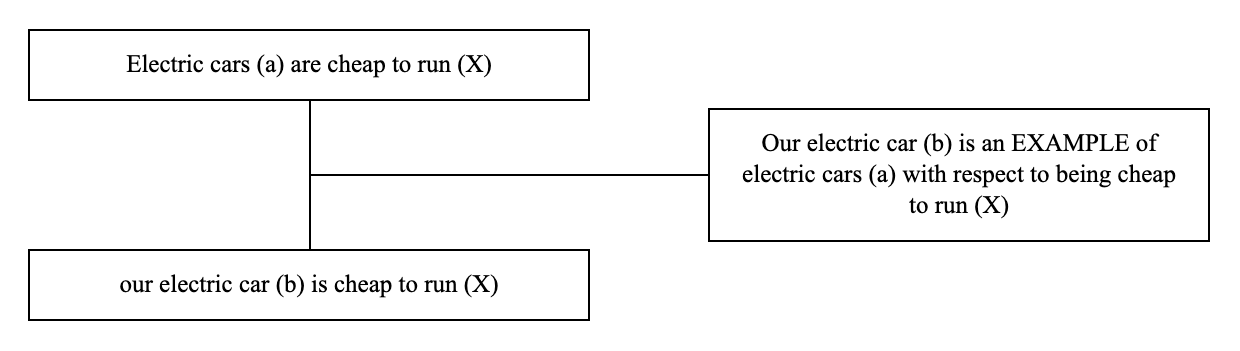
The keyword AN EXAMPLE OF describes the relationship between subjects a and b. The argument lever can thus be formulated as “Our electric car (b) is an EXAMPLE of electric cars (a) with respect to being cheap to run (X)”.
Assessment questions
- Is our electric car indeed cheap to run?
- Is our electric car a representative example of electric cars?
- Is one car enough to support a claim about electric cars in general, or is ours an exceptional case — a home charger, short trips, cheap night-time electricity — so that more examples, or data on average running costs, are needed?
Not to be confused with
- Argument from species — The premise is a kind within the class, covering some of its members, not one individual case.
up - Argument from totality — Runs the other way, from the whole class down to one case.
su - Argument from analogy — Both halves are about single cases of the same rank, with no class relation between them.
ss
Notes
Apart from beta form arguments with substance us, those with substance up or ps also fit the scheme, as the scope of the conclusion is broader than that of the premise. A beta form argument with substance us, up or ps that has statements of fact (F) as its conclusion and premise can also be called an argument from species.
Source of the example
Invented example.

