
Rhetoric-checking and argument-checking
José Plug and Jean Wagemans are developing procedures for what they call ‘rhetoric-checking’, an extension of fact-checking that includes an assessment of the argumentative quality of persuasive discourse. The sub procedure of ‘argument-checking’ makes use of the argument categorisation framework of the Periodic Table of Arguments. For more info, please see the project page on Argument-Checking of the thematic research group Language and Cognition in Argumentation (LANCAR).
Adpositional Rhetoric (AdRhet)
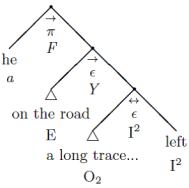
Federico Gobbo and Marco Benini, the founders of Constructive Adpositional Grammars (CxAdGrams), have teamed up with Jean Wagemans in order to develop a high precision tool for representing the linguistic and pragmatic features of arguments. The combination of their linguistic representation framework with the argument classification framework of the Periodic Table of Arguments (PTA) has yielded a method for building so-called ‘argumentative adpositional trees’ (or ‘arg-adtrees’). These enable the analyst of argumentative discourse not only to represent statements on the morphosyntactic level, but also to include information regarding the argumentative function of their constituents.
For more info please go to the project pages of Adpositional Rhetoric (AdRhet) on the website of the thematic research group Language and Cognition in Argumentation (LANCAR).
- Read the short paper Adpositional Argumentation (AdArg)
- Scholars interested in AI and Computational Argumentation are invited to read the long paper Annotation with Adpositional Argumentation: Guidelines for building a Gold Standard Corpus of argumentative discourse
- A somewhat less technical paper about the method is Building argumentative adpositional trees.
Annotated corpus of argument schemes
 Jacky Visser, John Lawrence, and Chris Reed of ARG-tech, the Centre for Argument Technology of the University of Dundee, are collaborating with Jean Wagemans for the purpose of developing an annotated corpus of argument schemes by combining Inference Anchoring Theory (IAT) with the Periodic Table of Arguments (PTA).
For more info please go to the project pages of Annotating Argumentation in the Wild on the website of the thematic research group Language and Cognition in Argumentation (LANCAR).
- The corpus is now available online at US2016G1tvWAGEMANS
- Read the paper An annotated corpus of argument schemes in US election debates
- The paper Annotating argument schemes contains a comparison between the uses of Douglas Walton’s classification of argument schemes and Jean Wagemans’ Periodic Table of Arguments.
 PERIODIC TABLE OF ARGUMENTS