
You should not stop buying guns because criminals have not stopped buying guns.
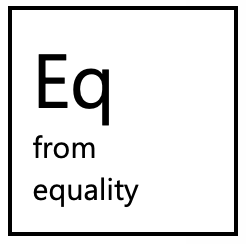
The subjects are different and the predicates are the same, so the argument form is beta (a is X because b is X): “You (a) should not stop buying guns (X) because criminals (b) have not stopped buying guns (X)”.
The conclusion is a singular statement (s) and the premise a universal statement (u), so the argument substance is su: “You should not stop buying guns (s) because criminals have not stopped buying guns (u)”.
The keyword EQUALITY describes the relationship between subjects a and b. The argument lever can thus be formulated as “You (a) are EQUAL to criminals (b)”.
Other examples
- Emma should have a salary raise because Peter had a salary raise.
- Dutch royals should pay taxes, because every other citizen pays taxes (taken from a news item stating that, according to a poll carried out by Dutch television program Een Vandaag, 62 percent of Dutch people think that King Willem-Alexander of the Netherlands, his wife Queen Máxima, and his mother Princess Beatrix should pay taxes just like every other citizen).
Notes
The literature often treats the argument from analogy, argument from similarity, argument from comparison, and argument from equality as if they were the same. In the PTA, “argument from analogy” remains a broad, umbrella label (much like “argument from sign” in the Alpha Quadrant). However, its parametric approach to argument categorization allows for a more precise distinction between the other three argument types by using the distinction between statements of fact (F), value (V), and policy (P) that is used to determine the value of argument substance in the Alpha Quadrant. Applying these labels, it turns out that, typically:
- the argument from similarity has an F-claim supported by an F-claim;
- the argument from comparison has a V-claim supported by a V-claim;
- and the argument from equality has a P-claim supported by an F-claim.
 PERIODIC TABLE OF ARGUMENTS