
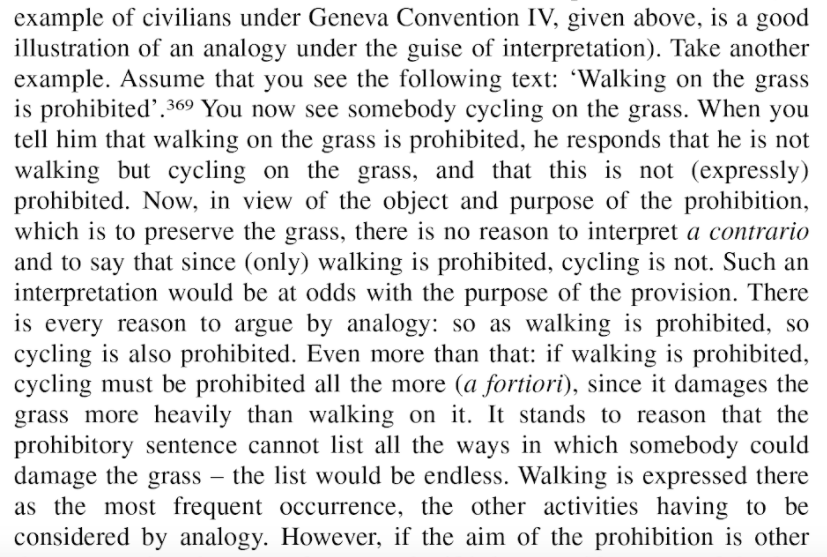
Cycling on the grass is prohibited because walking on the grass is prohibited.
The subjects are different and the predicates are the same, so the argument form is beta (a is X because b is X): “Cycling on the grass (a) is prohibited (X) because walking on the grass (b) is prohibited (X)”.
The conclusion is a singular statement (s) and the premise is a singular statement (s) too, so the argument substance is ss: “Cycling on the grass is prohibited (s) because walking on the grass is prohibited (s)”.
The keyword ANALOGY describes the relationship between subjects a and b. The argument lever can thus be formulated as “Cycling on the grass (a) is ANALOGOUS to walking on the grass (b)”.
Source
The example is taken from Kolb (2016, p. 152). (Kolb, R. (2016). The law of treaties. An introduction. Cheltenham: Edward Elgar Publishing.
Other examples
Notes
The literature often treats the argument from analogy, argument from similarity, argument from comparison, and argument from equality as if they were the same. In the PTA, “argument from analogy” remains a broad, umbrella label (much like “argument from sign” in the Alpha Quadrant). However, its parametric approach to argument categorization allows for a more precise distinction between the other three argument types by using the distinction between statements of fact (F), value (V), and policy (P) that is used to determine the value of argument substance in the Alpha Quadrant. Applying these labels, it turns out that, typically:
- the argument from similarity has an F-claim supported by an F-claim;
- the argument from comparison has a V-claim supported by a V-claim;
- and the argument from equality has a P-claim supported by an F-claim.
 PERIODIC TABLE OF ARGUMENTS